Pleasant Street Historic District

Why it's listed
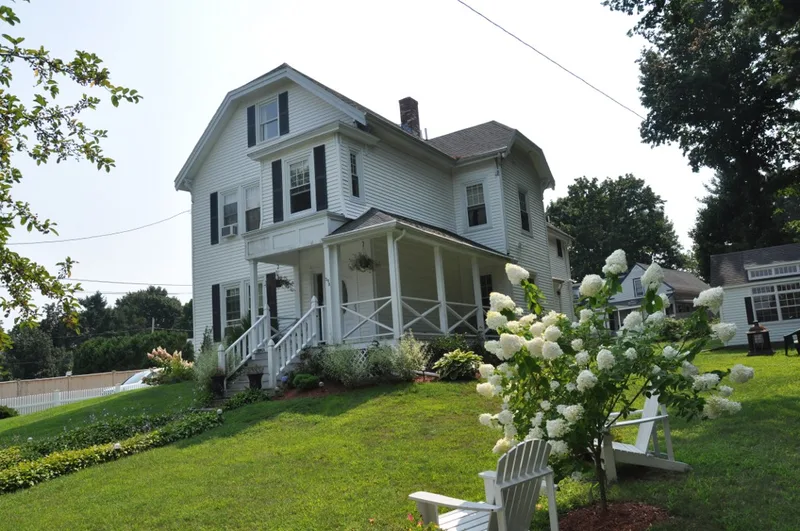
Pleasant Street Historic District is a short stretch of large houses on a hill crest in Marlborough, Massachusetts, running about 800 feet between Pearl and Spring Streets. The houses sit well back from a wide, tree-lined street on lots much larger than the city's usual 4,000 to 5,000 square feet. Eleven buildings contribute to the district and one, a 1961 school, does not. Most were built between the 1860s and the 1920s for shoe manufacturers and their relatives. Styles include Second Empire, Queen Anne, Colonial Revival and Mediterranean Revival, and two early Second Empire houses were later remodeled in Colonial Revival form. The district is notable for its architecture and for its social history. John A. Frye, founder of the J.A. Frye Shoe Company, acquired a Howe family house in the 1870s, and his children and grandchildren built or remodeled neighboring houses. The resulting family enclave lasted into the 1950s and shows how a business family settled together.
Significance in brief: The district is significant for architecture because it contains stylish examples of Second Empire, Queen Anne, Colonial Revival and Mediterranean Revival houses built for wealthy shoe manufacturers. It is also significant for social history, since most houses were built by members of the related Howe and Frye families, forming a tightly knit family enclave tied to the shoe industry.
Machine-generated summary. This summary was generated by a language model from the official nomination document and has not been reviewed line by line by an editor. It may contain errors. Check the source document before relying on any detail. Source: nomination document (PDF) · National Archives catalog entry. NRHP reference 01001061, listed September 27, 2001. Summary generated October 2026 (model claude-sonnet-5-5, prompt v1.0-2026-10-29, confidence high).
Key facts
| Address | 187-235 Pleasant St., Marlborough |
|---|---|
| County | Middlesex County |
| Listed | September 27, 2001 |
| Reference number | 01001061 |
| Resource type | District |
| Period of significance | ca. 1865-1951 |
| Architectural style | Second Empire, Queen Anne, Colonial Revival, Mediterranean |
| Criteria |
|
| Areas of significance | Architecture, Social History |
| Level of significance | Local |
| Status (as stated in the nomination) | Current functions are listed as single and multiple dwellings; the 1961 Immaculate Conception School is a noncontributing resource. |
| Acreage | 8.3 |
| Coordinates | 42.35031, -71.56321 (NPS GIS) |
What listing means for this property
This is a historic district. Buildings within its boundary are either contributing (they add to the district's significance) or non-contributing. Owners of contributing income-producing buildings can claim the 20% federal rehabilitation tax credit; homeowners should look at state credits. National Register districts impose no design review by themselves; a local historic district ordinance, if one exists, does (the difference explained).
General information, not legal or tax advice. Rules change; confirm with your State Historic Preservation Office or a qualified adviser.
Sources and further reading
- National Park Service, National Register of Historic Places database (snapshot May 2026), reference 01001061.
- Nomination form (PDF, National Archives) — catalog entry
- Wikipedia article (used for cross-checking only; text not reproduced here)
- Wikidata Q7203975
- This listing as JSON
Last updated October 2026. Found an error? See the editorial policy for how to report it.