Orchard House
Also known as: Alcott,Louisa May,House

Why it's listed
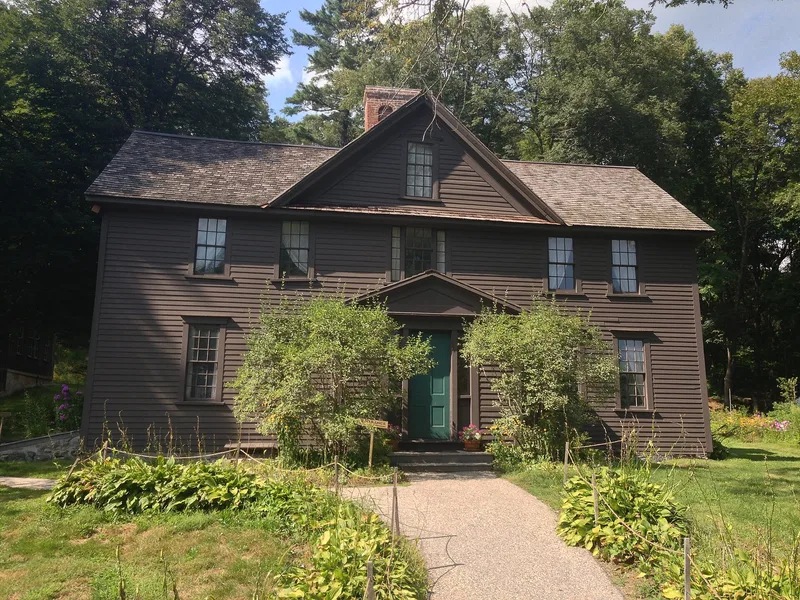
Orchard House, at 399 Lexington Road in Concord, Massachusetts, is a 2 1/2-story frame and clapboard house whose earliest portion dates to the 18th century. The Alcott family bought it in 1857 and enlarged and altered it, giving it most of its present appearance. Bronson Alcott, an author, educator and Transcendental philosopher, lived here with his family for 25 years. His daughter Louisa May Alcott wrote part of Little Women in the house, and her other children's books include An Old-Fashioned Girl, Little Men and Eight Cousins. About 75 feet away stands the plain, unpainted School of Philosophy, built in 1879 for the Concord Summer School of Philosophy and Literature, an early adult summer school in the eastern United States. It operated until Alcott's death in 1888. The Alcotts sold the house in 1882, and the Concord Woman's Club bought it in 1911 as a memorial to Louisa May Alcott. A memorial association now runs it as a museum.
Significance in brief: It was the home of Bronson Alcott and his family for 25 years, and Louisa May Alcott wrote part of Little Women there. Bronson Alcott, an author, educator and Transcendental philosopher, founded the Concord Summer School of Philosophy and Literature, one of the first adult summer schools in the eastern United States, in the building beside the house.
Machine-generated summary. This summary was generated by a language model from the official nomination document and has not been reviewed line by line by an editor. It may contain errors. Check the source document before relying on any detail. Source: nomination document (PDF) · National Archives catalog entry. NRHP reference 66000781, listed October 15, 1966. Summary generated October 2026 (model claude-sonnet-5-5, prompt v1.0-2026-10-29, confidence high).
Key facts
| Address | Lexington Rd., Concord |
|---|---|
| County | Middlesex County |
| Listed | October 15, 1966 |
| Reference number | 66000781 |
| Resource type | Building |
| Period of significance | 1857-1882 |
| Architect / builder | not known |
| Areas of significance | Literature |
| Level of significance | National |
| National Historic Landmark | Yes, designated December 29, 1962 |
| Status (as stated in the nomination) | Operated as a museum and open to the public from April to November; described as in good condition, though in need of repainting and minor repair. |
| Acreage | 2.1 |
| Coordinates | 42.45914, -71.33532 (NPS GIS) |
What listing means for this property
National Register listing is honorary for a privately owned home: it does not by itself restrict what an owner may do with their own money, and it does not require public access. Restrictions come from local landmark or historic-district ordinances, which are separate (how they differ).
Owner-occupied houses are not eligible for the 20% federal rehabilitation tax credit, which applies to income-producing buildings, but many states offer credits for homeowners. Listing also opens the door to preservation easements and to buying a plaque. Start with what listing means for homeowners, renovating a listed house and selling one.
General information, not legal or tax advice. Rules change; confirm with your State Historic Preservation Office or a qualified adviser.
Sources and further reading
- National Park Service, National Register of Historic Places database (snapshot May 2026), reference 66000781.
- Nomination form (PDF, National Archives) — catalog entry
- Wikipedia article (used for cross-checking only; text not reproduced here)
- Wikidata Q7100190
- This listing as JSON
Last updated October 2026. Found an error? See the editorial policy for how to report it.