Longfellow House-Washingtons Headquarters National Historic Site (Additional Documentation)
Also known as: Vassall House; Castle Craigie; Vassall-Craigie-Longfellow House; Henry W. Longfellow Place; Longfellow National Historic Site

Why it's listed
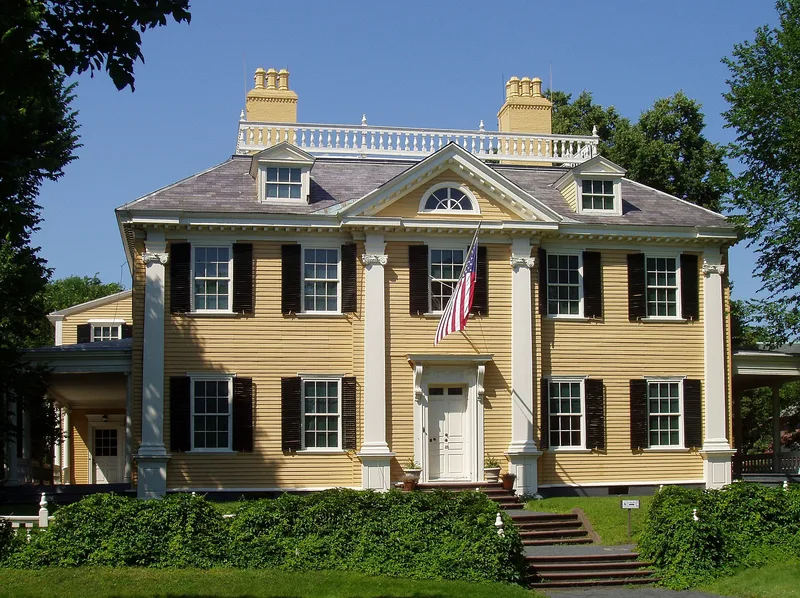
At 105 Brattle Street in Cambridge, Massachusetts, a Georgian house built about 1759 for John Vassall Jr. sits on 1.98 acres with a carriage house, barn and formal garden. The two-story wood-frame house has a pedimented central pavilion with giant Ionic pilasters, a balustraded roof and a staircase with Baroque detailing. Andrew Craigie added piazzas and a rear ell after 1791. The carriage house and barn, built in 1844 for Henry Wadsworth Longfellow, mixes Greek Revival, Italianate and early Victorian features. The house served as a hospital for colonial wounded and as George Washington's headquarters from July 1775 to April 1776. Longfellow lived there from 1837 until his death in 1882, and his daughter Alice remained until 1928. The garden he designed, the original furnishings, and the study where he wrote are preserved. The National Park Service acquired the property in 1973, together with a large collection of art, books and manuscripts.
Significance in brief: The nomination argues that the site is significant for both architecture and associations. The house is a leading New England example of High Georgian design combining Palladian and Baroque elements. It served as George Washington's headquarters in 1775-1776 and was the long-time home of poet Henry Wadsworth Longfellow.
Machine-generated summary. This summary was generated by a language model from the official nomination document and has not been reviewed line by line by an editor. It may contain errors. Check the source document before relying on any detail. Source: nomination document (PDF) · National Archives catalog entry. NRHP reference 66000049, listed October 15, 1966. Summary generated October 2026 (model claude-sonnet-5-5, prompt v1.0-2026-10-29, confidence medium).
Key facts
| Address | Address restricted by the NPS (common for archaeological sites and some private homes) |
|---|---|
| County | Middlesex County |
| Listed | October 15, 1966 |
| Reference number | 66000049 |
| Resource type | District |
| Architect / builder | John Vassall, Jr. (house, 1759); Andrew Craigie (1790s additions); carriage house and barn designed for Longfellow (1844) |
| Architectural style | New England High Georgian (English Palladian and Baroque elements); carriage house with Greek Revival, Italianate and early Victorian features |
| Areas of significance | Military, Literature, Architecture, Conservation, Social History, Landscape Architecture, Archeology-Prehistoric, Archeology-Historic Non-Aboriginal |
| Level of significance | National, State |
| National Historic Landmark | Yes, designated December 19, 1962 |
| Status (as stated in the nomination) | Federally owned and occupied; condition marked fair and unaltered. The National Park Service acquired the house in 1973 along with a large collection of furnishings, art and manuscripts. |
| Acreage | 1.98 |
| Coordinates | 42.37701, -71.12638 (NPS GIS) |
What listing means for this property
This is a historic district. Buildings within its boundary are either contributing (they add to the district's significance) or non-contributing. Owners of contributing income-producing buildings can claim the 20% federal rehabilitation tax credit; homeowners should look at state credits. National Register districts impose no design review by themselves; a local historic district ordinance, if one exists, does (the difference explained).
General information, not legal or tax advice. Rules change; confirm with your State Historic Preservation Office or a qualified adviser.
Sources and further reading
- National Park Service, National Register of Historic Places database (snapshot May 2026), reference 66000049.
- Nomination form (PDF, National Archives) — catalog entry
- Wikipedia article (used for cross-checking only; text not reproduced here)
- Wikidata Q474665
- This listing as JSON
Last updated October 2026. Found an error? See the editorial policy for how to report it.