Berkeley Street Historic District
Also known as: See Also:Berkeley Street Historic District (Boundary Increas

Why it's listed
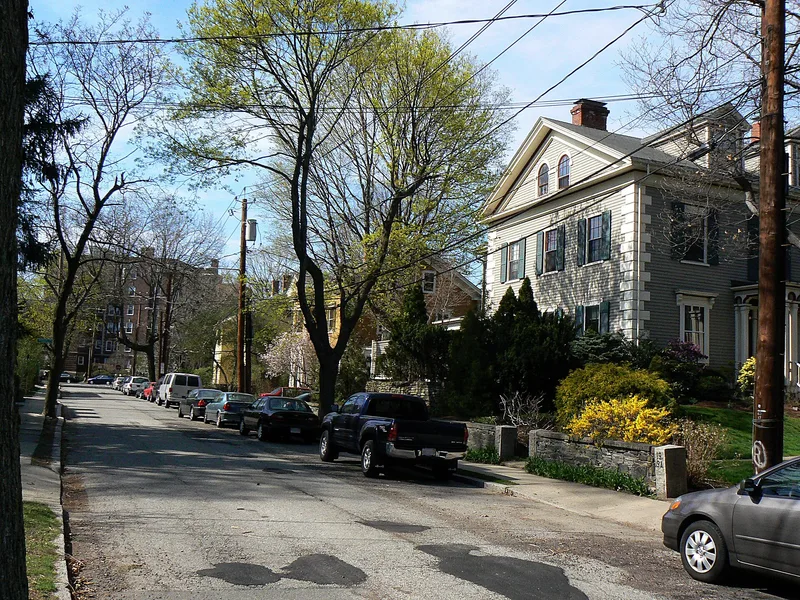
Berkeley Street and Berkeley Place form a quiet residential enclave in Old Cambridge, Massachusetts. The land was part of a thirty-seven acre parcel bought in 1843 by Professor Joseph Worcester, who laid out the street in the early 1850s and sold lots for expensive houses. Most early houses are large Bracketed Italianate and Mansard homes built between 1852 and 1878, including T-plan suburban houses and the only textbook Italian Villa in Old Cambridge. Later Queen Anne, Shingle Style and Stucco Style houses, including Berkeley Place, laid out in 1890, follow the mass and siting of the earlier ones. The district is notable for architectural unity and for residents such as author Richard Henry Dana, historian John Fiske and Henry Ware, a state official who helped found the Boston symphony orchestra. Cul-de-sac Berkeley Place and brick buildings nearby leave the area feeling isolated from the surrounding city.
Significance in brief: The district holds what the form calls the best concentration of Bracketed Italianate and Mansard houses in Cambridge, within a quiet, cohesive street setting. It is significant under Criterion C for its architecture and under Criterion B for associations with people in literature and education. Residents included Richard Henry Dana and John Fiske.
Machine-generated summary. This summary was generated by a language model from the official nomination document and has not been reviewed line by line by an editor. It may contain errors. Check the source document before relying on any detail. Source: nomination document (PDF) · National Archives catalog entry. NRHP reference 82001920, listed April 13, 1982. Summary generated October 2026 (model claude-sonnet-5-5, prompt v1.0-2026-10-29, confidence high).
Key facts
| Address | Berkeley St., Cambridge |
|---|---|
| County | Middlesex County |
| Listed | April 13, 1982 |
| Reference number | 82001920 |
| Resource type | District |
| Period of significance | 1850-1900 |
| Architect / builder | Calvin Ryder; Oliver Hastings; Griffith Thomas; William Ralph Emerson; Dwight & Chandler; Kilham & Hopkins; Hartley Dennett; A.W. Jackson; Moses and Jedediah Ricker; Jonas Wyeth III |
| Architectural style | Bracketed Italianate, Mansard, Queen Anne/Shingle Style, Stucco Style |
| Criteria |
|
| Areas of significance | Architecture |
| Level of significance | State |
| Status (as stated in the nomination) | Described as uniform in good to excellent condition, privately owned and in residential use. One house at 24 Berkeley Street (1936) is the only non-contributing building. |
| Acreage | 4.9 |
| Within district | Berkeley Street Historic District (Boundary Increase) |
| Coordinates | 42.37800, -71.12509 (NPS GIS) |
What listing means for this property
This is a historic district. Buildings within its boundary are either contributing (they add to the district's significance) or non-contributing. Owners of contributing income-producing buildings can claim the 20% federal rehabilitation tax credit; homeowners should look at state credits. National Register districts impose no design review by themselves; a local historic district ordinance, if one exists, does (the difference explained).
General information, not legal or tax advice. Rules change; confirm with your State Historic Preservation Office or a qualified adviser.
Sources and further reading
- National Park Service, National Register of Historic Places database (snapshot May 2026), reference 82001920.
- Nomination form (PDF, National Archives) — catalog entry
- Wikipedia article (used for cross-checking only; text not reproduced here)
- Wikidata Q4892113
- This listing as JSON
Last updated October 2026. Found an error? See the editorial policy for how to report it.