Kendall, Deacon Thomas, House

Why it's listed
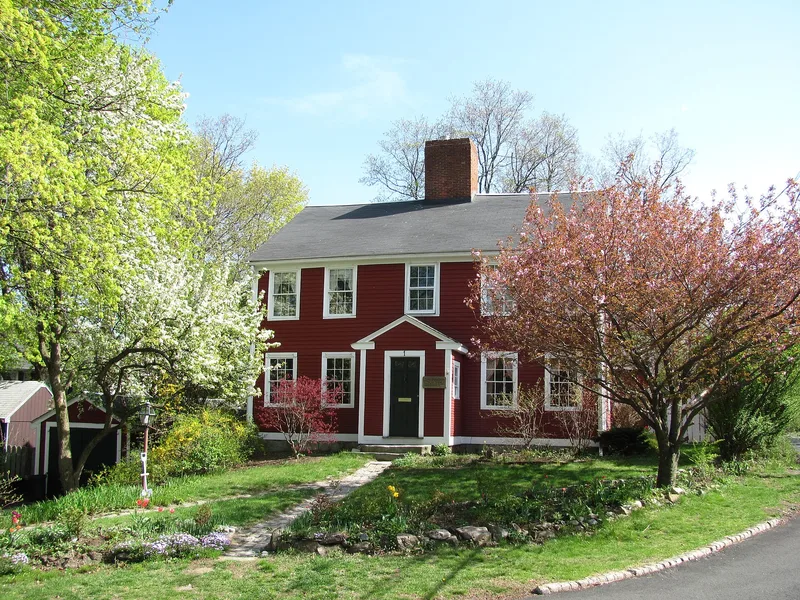
One Prospect Street in Wakefield holds a clapboard house that looks Federal from the outside but carries traces of an older building. It has five bays, two and a half stories, and no eaves returns in the gable ends, a trait of early Federal houses in the town. Its large central chimney is regarded as the oldest part, dating to the mid-17th century. Some window surrounds have finely carved moldings and corner blocks, probably from an earlier period, while smaller second-story windows on the south side look Georgian in proportion. The site is linked to Deacon Thomas Kendall, an early Reading settler from Lynn who served as deacon and selectman until his death in 1681. Later the James Emerson family owned it. A fire in 1786 killed Mrs. Emerson, and the house was probably rebuilt then, reusing older materials. The Emersons farmed shrinking land here through the 19th century. The house is valued as a well-preserved local example of early Federal design.
Significance in brief: The house is considered a well-preserved example of an early Federal period design in Wakefield, though it incorporates elements of an earlier structure burned in 1786. Its large central chimney is thought to be the oldest feature, dating from the mid-17th century. It is also tied to Deacon Thomas Kendall, an early settler, and to the Emerson family, who farmed the land through the 19th century.
Machine-generated summary. This summary was generated by a language model from the official nomination document and has not been reviewed line by line by an editor. It may contain errors. Check the source document before relying on any detail. Source: nomination document (PDF) · National Archives catalog entry. NRHP reference 89000742, listed July 6, 1989. Summary generated October 2026 (model claude-sonnet-5-5, prompt v1.0-2026-10-29, confidence medium).
Key facts
| Address | One Prospect St., Wakefield |
|---|---|
| County | Middlesex County |
| Listed | July 6, 1989 |
| Reference number | 89000742 |
| Resource type | Building |
| Architectural style | Federal |
| Criteria |
|
| Areas of significance | Architecture |
| Level of significance | Local |
| Status (as stated in the nomination) | Recorded in good condition and in use as a dwelling; a single-car garage and enclosed porch were added in the early 1900s. |
| Acreage | 0.9 |
| Coordinates | 42.50572, -71.07952 (NPS GIS) |
What listing means for this property
National Register listing is honorary for a privately owned home: it does not by itself restrict what an owner may do with their own money, and it does not require public access. Restrictions come from local landmark or historic-district ordinances, which are separate (how they differ).
Owner-occupied houses are not eligible for the 20% federal rehabilitation tax credit, which applies to income-producing buildings, but many states offer credits for homeowners. Listing also opens the door to preservation easements and to buying a plaque. Start with what listing means for homeowners, renovating a listed house and selling one.
General information, not legal or tax advice. Rules change; confirm with your State Historic Preservation Office or a qualified adviser.
Sources and further reading
- National Park Service, National Register of Historic Places database (snapshot May 2026), reference 89000742.
- Nomination form (PDF, National Archives) — catalog entry
- Wikipedia article (used for cross-checking only; text not reproduced here)
- Wikidata Q5245040
- This listing as JSON
Last updated October 2026. Found an error? See the editorial policy for how to report it.