House at 309 Waltham Street

Why it's listed
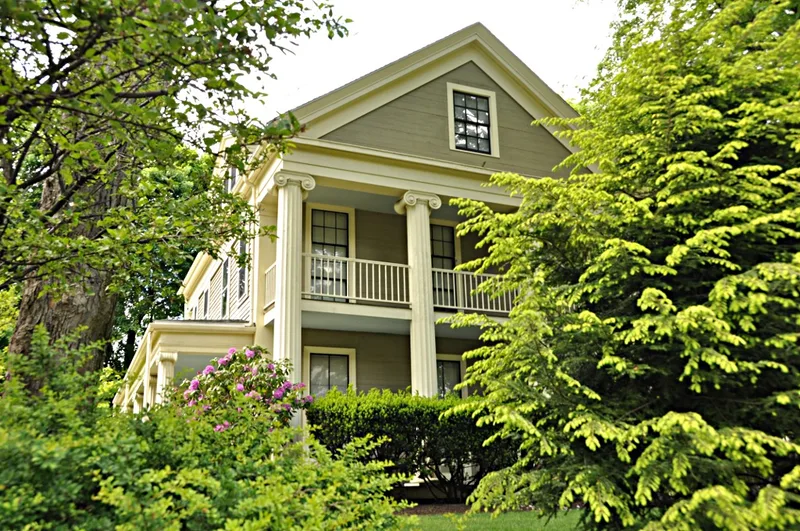
Built around 1835 in West Newton, this clapboard house on Waltham Street is a temple-fronted Greek Revival residence. Monumental Ionic columns support the front portico, which has a second-level balcony, and an Ionic colonnade runs along the side porch. Virtually all of its original detailing survives, and the building has had no major alterations. About six intact Greek Revival temple-front houses remain in Newton, and most of them share the same four-columned Ionic portico seen here. Its early ownership is uncertain, though a J. C. Jones owned it in 1855. Around 1862 it passed to Joseph A. Newell, a Boston boot and shoe dealer whose large store at Essex and Chauncy streets was known across much of New England. Later owners included Frederick W. Yelland and Albert W. Gilmore. It was listed for its architectural quality as a well-preserved example of high-style Greek Revival design.
Significance in brief: The nomination argues the house is a well-preserved example of high-styled Greek Revival architecture in Newton, meeting criterion C. It keeps virtually all of its original detailing, including a four-columned Ionic portico. It is one of only about six intact Greek Revival temple-front houses remaining in the city.
Machine-generated summary. This summary was generated by a language model from the official nomination document and has not been reviewed line by line by an editor. It may contain errors. Check the source document before relying on any detail. Source: nomination document (PDF) · National Archives catalog entry. NRHP reference 86001828, listed September 4, 1986. Summary generated October 2026 (model claude-sonnet-5-5, prompt v1.0-2026-10-29, confidence high).
Key facts
| Address | 309 Waltham St., Newton |
|---|---|
| County | Middlesex County |
| Listed | September 4, 1986 |
| Reference number | 86001828 |
| Resource type | Building |
| Architectural style | Greek Revival |
| Criteria |
|
| Areas of significance | Architecture |
| Level of significance | State, Local |
| Status (as stated in the nomination) | Recorded in good condition, with no major alterations, no outbuildings, and not moved; present use is residence. |
| Acreage | 0.3 |
| Coordinates | 42.35650, -71.22369 (NPS GIS) |
What listing means for this property
National Register listing is honorary for a privately owned home: it does not by itself restrict what an owner may do with their own money, and it does not require public access. Restrictions come from local landmark or historic-district ordinances, which are separate (how they differ).
Owner-occupied houses are not eligible for the 20% federal rehabilitation tax credit, which applies to income-producing buildings, but many states offer credits for homeowners. Listing also opens the door to preservation easements and to buying a plaque. Start with what listing means for homeowners, renovating a listed house and selling one.
General information, not legal or tax advice. Rules change; confirm with your State Historic Preservation Office or a qualified adviser.
Sources and further reading
- National Park Service, National Register of Historic Places database (snapshot May 2026), reference 86001828.
- Nomination form (PDF, National Archives) — catalog entry
- Wikipedia article (used for cross-checking only; text not reproduced here)
- Wikidata Q14715579
- This listing as JSON
Last updated October 2026. Found an error? See the editorial policy for how to report it.