Gray, Asa, House

Why it's listed
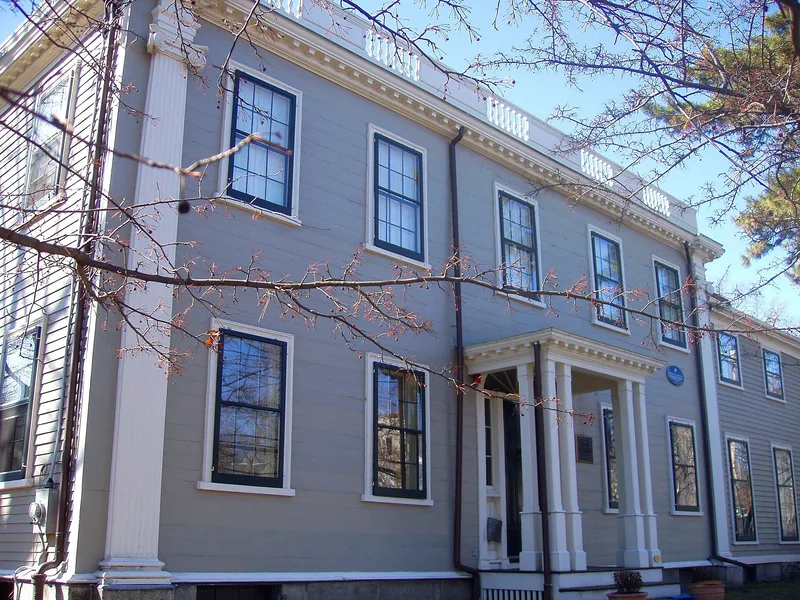
Built in 1810 on the grounds of Harvard College's Botanic Garden, this two-story frame house was designed by Ithiel Town, whose earliest known work it is. The Massachusetts Society for Promoting Agriculture built it as the home of zoologist William Dandridge Peck. Later occupants included botanist Thomas Nuttall and Harvard presidents James Walker and Jared Sparks. Asa Gray lived here from 1842 until his death in 1888 while serving as Massachusetts Professor of Natural History at Harvard. Gray published the first complete books on North American flora, adopted the natural system of plant classification, identified the relationship between the plants of eastern North America and east Asia, and defended Darwin's Origin of Species in America. The house was moved in 1910 to 88 Garden Street. It has a center-hall plan, a wing that held Gray's study with museum cabinets, and later additions. It remains a private residence.
Significance in brief: It is the earliest known work of architect Ithiel Town and was the home of botanist Asa Gray from 1842 until his death in 1888. Gray wrote the first complete books on North American flora, adopted the natural system of plant classification, and was a leading American defender of Darwin's theory of evolution.
Machine-generated summary. This summary was generated by a language model from the official nomination document and has not been reviewed line by line by an editor. It may contain errors. Check the source document before relying on any detail. Source: nomination document (PDF) · National Archives catalog entry. NRHP reference 66000655, listed October 15, 1966. Summary generated October 2026 (model claude-sonnet-5-5, prompt v1.0-2026-10-29, confidence high).
Key facts
| Address | 88 Garden St., Cambridge |
|---|---|
| County | Middlesex County |
| Listed | October 15, 1966 |
| Reference number | 66000655 |
| Resource type | Building |
| Period of significance | 1810; 1842-1888 |
| Architect / builder | Ithiel Town (designer); built by the Massachusetts Society for Promoting Agriculture |
| Areas of significance | Science |
| Level of significance | National |
| National Historic Landmark | Yes, designated January 12, 1965 |
| Status (as stated in the nomination) | Used as a private residence, not open to the public; in fair condition, needing repainting, with some exterior woodwork appearing to decay. |
| Acreage | 0.3 |
| Coordinates | 42.38291, -71.12806 (NPS GIS) |
What listing means for this property
National Register listing is honorary for a privately owned home: it does not by itself restrict what an owner may do with their own money, and it does not require public access. Restrictions come from local landmark or historic-district ordinances, which are separate (how they differ).
Owner-occupied houses are not eligible for the 20% federal rehabilitation tax credit, which applies to income-producing buildings, but many states offer credits for homeowners. Listing also opens the door to preservation easements and to buying a plaque. Start with what listing means for homeowners, renovating a listed house and selling one.
General information, not legal or tax advice. Rules change; confirm with your State Historic Preservation Office or a qualified adviser.
Sources and further reading
- National Park Service, National Register of Historic Places database (snapshot May 2026), reference 66000655.
- Nomination form (PDF, National Archives) — catalog entry
- Wikipedia article (used for cross-checking only; text not reproduced here)
- Wikidata Q4803125
- This listing as JSON
Last updated October 2026. Found an error? See the editorial policy for how to report it.