Crystal Lake and Pleasant Street Historic District

Why it's listed
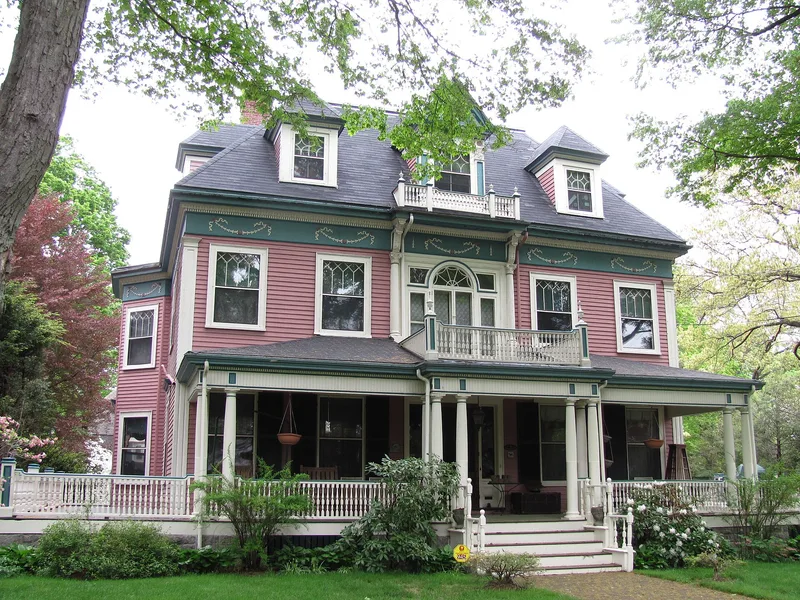
Crystal Lake and Pleasant Street Historic District is a residential neighborhood of about 8.3 acres in Newton Centre, Massachusetts, covering houses along Pleasant Street and along Lake Avenue at the north edge of Crystal Lake. Once mostly farmland and woods, the area began to develop after the Charles River Branch railroad was extended through Newton and Beacon Street was pushed westward. Roswell Turner, who had assembled land here in the 1840s, helped lay out Lake Avenue, and later Charles Davis, a piano manufacturer, bought several of his properties. The Pleasant Street houses date from the 1860s and the Lake Avenue houses from the 1880s and 1890s. The district contains the city's best group of Carpenter Gothic cottages, with scroll-sawn ornament inspired by A.J. Downing's pattern books. Italianate, Mansard, Stick Style, Queen Anne and Colonial Revival houses show how the neighborhood grew into a fashionable commuter suburb. Of 23 buildings, 3 are non-contributing.
Significance in brief: The district is a cohesive grouping of residences built for suburban commuters after the Charles River Branch railroad was extended in the 1850s. It also holds the city's finest grouping of Carpenter Gothic houses and a range of high-quality mid- to late-nineteenth century styles.
Machine-generated summary. This summary was generated by a language model from the official nomination document and has not been reviewed line by line by an editor. It may contain errors. Check the source document before relying on any detail. Source: nomination document (PDF) · National Archives catalog entry. NRHP reference 86001735, listed September 4, 1986. Summary generated October 2026 (model claude-sonnet-5-5, prompt v1.0-2026-10-29, confidence medium).
Key facts
| Address | Roughly bounded by Sudbury Aqueduct, Pleasant Ave., Lake Ave., and Crystal St. and Webster Ct., Newton |
|---|---|
| County | Middlesex County |
| Listed | September 4, 1986 |
| Reference number | 86001735 |
| Resource type | District |
| Period of significance | 1860-1895 |
| Architectural style | Carpenter Gothic, Italianate, Gothic Revival, Mansard, Queen Anne, Stick Style and Colonial Revival |
| Criteria |
|
| Areas of significance | Architecture, Social History |
| Level of significance | State, Local |
| Status (as stated in the nomination) | Present use is residential; general condition is described as very good. The inventory lists 23 buildings, 3 of them non-contributing. |
| Acreage | 8.3 |
| Coordinates | 42.33101, -71.20026 (NPS GIS) |
What listing means for this property
This is a historic district. Buildings within its boundary are either contributing (they add to the district's significance) or non-contributing. Owners of contributing income-producing buildings can claim the 20% federal rehabilitation tax credit; homeowners should look at state credits. National Register districts impose no design review by themselves; a local historic district ordinance, if one exists, does (the difference explained).
General information, not legal or tax advice. Rules change; confirm with your State Historic Preservation Office or a qualified adviser.
Sources and further reading
- National Park Service, National Register of Historic Places database (snapshot May 2026), reference 86001735.
- Nomination form (PDF, National Archives) — catalog entry
- Wikipedia article (used for cross-checking only; text not reproduced here)
- Wikidata Q5191266
- This listing as JSON
Last updated October 2026. Found an error? See the editorial policy for how to report it.