Bridgman, Percy, House
Also known as: Bridgman House--Buckingham School

Why it's listed
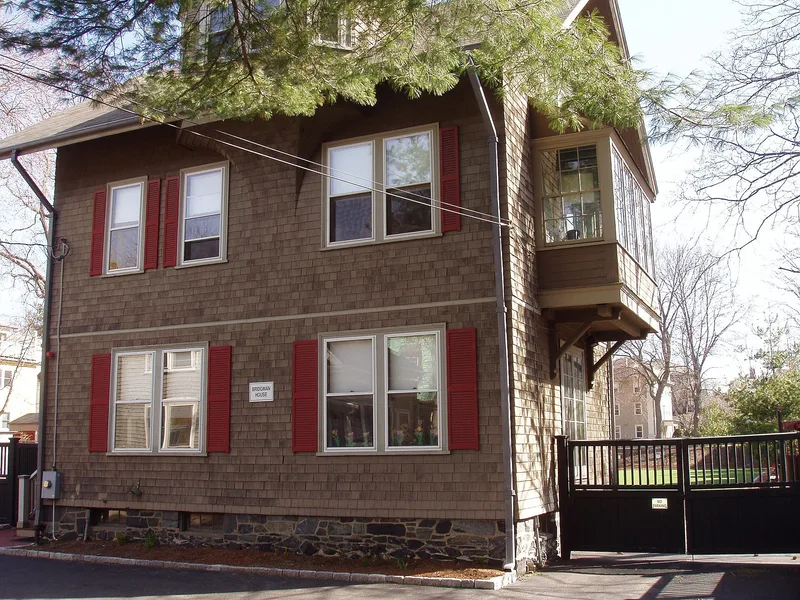
Ten Buckingham Place in Cambridge, Massachusetts, is a two-and-one-half story frame house built around 1920. Its architect is unknown, and the nomination notes that the house and three similar ones in the same subdivision are of little architectural importance. Its significance comes from its resident. Physicist Percy Williams Bridgman moved in during 1928 and lived there until his death in 1961. Bridgman spent his entire academic career at Harvard and pioneered the study of matter under high pressure, designing and building his own apparatus. He received the 1946 Nobel Prize in physics for that work. He also developed the idea of operational analysis, holding that a physical concept has meaning only through the operations used to measure it; social scientists later adopted the approach. After his death the Buckingham School acquired the property, and it still serves as a residence and faculty lounge. The nomination reports that the house remains largely unchanged since Bridgman's time.
Significance in brief: The nomination argues that the house is significant for its association with Percy Williams Bridgman, who won the 1946 Nobel Prize in physics for his work on high pressure physics. It also cites his concept of operational analysis, later adopted by social scientists. The house itself is not considered architecturally important.
Machine-generated summary. This summary was generated by a language model from the official nomination document and has not been reviewed line by line by an editor. It may contain errors. Check the source document before relying on any detail. Source: nomination document (PDF) · National Archives catalog entry. NRHP reference 75000298, listed May 15, 1975. Summary generated October 2026 (model claude-sonnet-5-5, prompt v1.0-2026-10-29, confidence high).
Key facts
| Address | 10 Buckingham Pl., Cambridge |
|---|---|
| County | Middlesex County |
| Listed | May 15, 1975 |
| Reference number | 75000298 |
| Resource type | Building |
| Period of significance | 1900- |
| Architectural style | Vernacular (described in the description section as neo-rationalism) |
| Areas of significance | Science |
| Level of significance | National |
| National Historic Landmark | Yes, designated May 15, 1975 |
| Status (as stated in the nomination) | Used by the Buckingham School as a residence and faculty lounge; condition excellent, with no significant changes since 1961. |
| Acreage | 0.9 |
| Coordinates | 42.37921, -71.12862 (NPS GIS) |
What listing means for this property
National Register listing is honorary for a privately owned home: it does not by itself restrict what an owner may do with their own money, and it does not require public access. Restrictions come from local landmark or historic-district ordinances, which are separate (how they differ).
Owner-occupied houses are not eligible for the 20% federal rehabilitation tax credit, which applies to income-producing buildings, but many states offer credits for homeowners. Listing also opens the door to preservation easements and to buying a plaque. Start with what listing means for homeowners, renovating a listed house and selling one.
General information, not legal or tax advice. Rules change; confirm with your State Historic Preservation Office or a qualified adviser.
Sources and further reading
- National Park Service, National Register of Historic Places database (snapshot May 2026), reference 75000298.
- Nomination form (PDF, National Archives) — catalog entry
- Wikipedia article (used for cross-checking only; text not reproduced here)
- Wikidata Q7167631
- This listing as JSON
Last updated October 2026. Found an error? See the editorial policy for how to report it.