Bassett, Edwin, House

Why it's listed
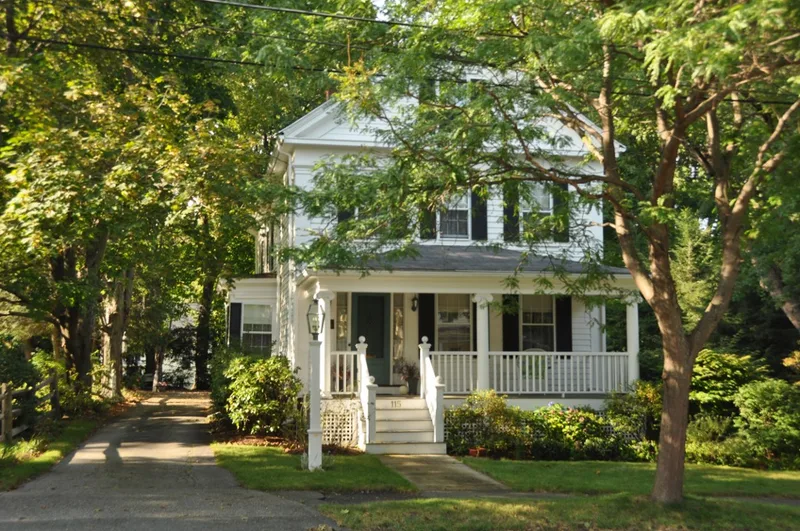
Built soon after Edwin Bassett bought the lot in May 1850, this clapboard house at 115 Prescott Street in Reading is a 3-bay Greek Revival dwelling. Its full pediment in the gable is unusual for the town. Other period features include a door surround with flat pilasters, a wide frieze that wraps the house, a tall central chimney and 6/6 windows. A Queen Anne porch on the south facade, a smaller one on the east, and probably the bay window were added later. Prescott Street was laid out in 1845 after rail commuter service to Boston opened. Bassett made infant and children's shoes, a Reading specialty. In a second-floor room of his house the town's first MacKay sewing machine was installed. It attached shoe uppers to soles mechanically and helped move production from hand-cottage work to mechanical factories. The property was recognized for its place in the local shoemaking industry, its link to Bassett, and its architecture.
Significance in brief: The nomination cites its role in Reading's shoemaking industry, since the first MacKay sewing machine in town was installed in an upstairs room. It also connects to Edwin Bassett, an innovative shoemaker, and is an example of a Greek Revival house updated with a Queen Anne porch.
Machine-generated summary. This summary was generated by a language model from the official nomination document and has not been reviewed line by line by an editor. It may contain errors. Check the source document before relying on any detail. Source: nomination document (PDF) · National Archives catalog entry. NRHP reference 84002482, listed July 19, 1984. Summary generated October 2026 (model claude-sonnet-5-5, prompt v1.0-2026-10-29, confidence medium).
Key facts
| Address | 115 Prescott St., Reading |
|---|---|
| County | Middlesex County |
| Listed | July 19, 1984 |
| Reference number | 84002482 |
| Resource type | Building |
| Architect / builder | Edwin Bassett (original owner and builder); architect n/a |
| Architectural style | Greek Revival |
| Criteria |
|
| Areas of significance | Industry, Architecture |
| Level of significance | Local |
| Acreage | 0.5 |
| Coordinates | 42.51895, -71.11441 (NPS GIS) |
What listing means for this property
National Register listing is honorary for a privately owned home: it does not by itself restrict what an owner may do with their own money, and it does not require public access. Restrictions come from local landmark or historic-district ordinances, which are separate (how they differ).
Owner-occupied houses are not eligible for the 20% federal rehabilitation tax credit, which applies to income-producing buildings, but many states offer credits for homeowners. Listing also opens the door to preservation easements and to buying a plaque. Start with what listing means for homeowners, renovating a listed house and selling one.
General information, not legal or tax advice. Rules change; confirm with your State Historic Preservation Office or a qualified adviser.
Sources and further reading
- National Park Service, National Register of Historic Places database (snapshot May 2026), reference 84002482.
- Nomination form (PDF, National Archives) — catalog entry
- Wikipedia article (used for cross-checking only; text not reproduced here)
- Wikidata Q5346244
- This listing as JSON
Last updated October 2026. Found an error? See the editorial policy for how to report it.