Church Street Historic District

Why it's listed
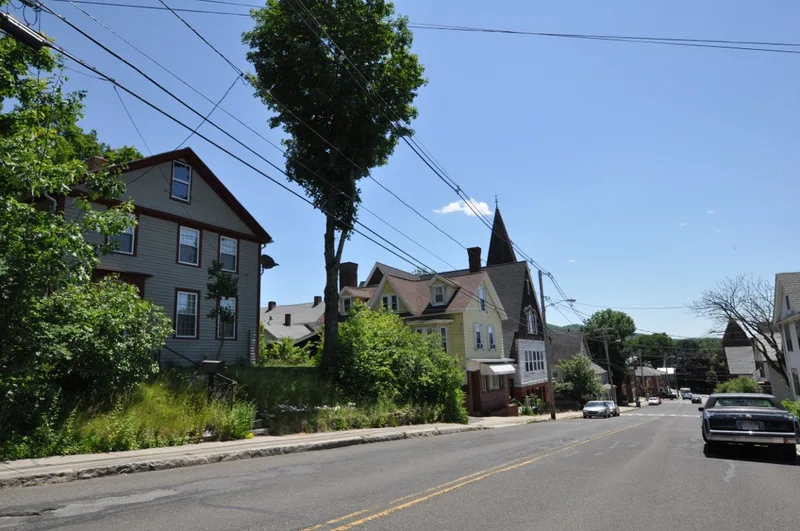
Church Street in Ware Village forms the spine of a residential district of 73 inventoried properties between Park Avenue and Highland Street, with a few adjacent cross-street lots and the open land of Greenville Park. Nearly all buildings are houses, and the only exceptions are a church, a school and the park. Almost all are wood-frame; the Larmarine double-house and the former Ware High School are the exceptions. The lower blocks near Main Street developed first, mostly in the 1840s to 1860s, and show strong Greek Revival character. The upper blocks were built up from the late 1880s through the early 1900s and are dominated by the Queen Anne style. Many town-lot barns and carriage houses survive, several of them elaborated in Queen Anne manner. The tree-lined street has an almost boulevard quality. The district includes workers' tenements, merchants' and physicians' homes, and the 1925 Colonial Revival East Congregational Church. Seventy of the properties contribute to the district's character.
Significance in brief: The visible text gives only the description and boundary justification, with no Section 8 statement. It describes a cohesive, tree-lined streetscape with Greek Revival houses on lower Church Street and Queen Anne houses on the upper blocks. It also notes an unusual concentration of early town-lot barns and carriage houses, and 70 of the 73 properties contribute to the district.
Machine-generated summary. This summary was generated by a language model from the official nomination document and has not been reviewed line by line by an editor. It may contain errors. Check the source document before relying on any detail. Source: nomination document (PDF) · National Archives catalog entry. NRHP reference 86001246, listed May 23, 1986. Summary generated October 2026 (model claude-sonnet-5-5, prompt v1.0-2026-10-29, confidence medium).
Key facts
| Address | Church St. between Park Ave. and Highland St., Ware |
|---|---|
| County | Hampshire County |
| Listed | May 23, 1986 |
| Reference number | 86001246 |
| Resource type | District |
| Architect / builder | Frohman, Robb & Little of Boston (East Congregational Church, 1925); Isaac Damon of Northampton (earlier 1826 church); P.H. Provencal (contractor, Sibley house) |
| Architectural style | Greek Revival (lower Church Street) and Queen Anne (upper Church Street), with Colonial Revival, Stick style and Craftsman-Bungalow examples |
| Areas of significance | Community Planning and Development, Architecture, Social History |
| Level of significance | Local |
| Status (as stated in the nomination) | The classification marks the district as occupied. Uses include private residences, a church, a school, a park, and bed-and-breakfast rental. |
| Acreage | 160 |
| Coordinates | 42.26675, -72.22983 (NPS GIS) |
What listing means for this property
This is a historic district. Buildings within its boundary are either contributing (they add to the district's significance) or non-contributing. Owners of contributing income-producing buildings can claim the 20% federal rehabilitation tax credit; homeowners should look at state credits. National Register districts impose no design review by themselves; a local historic district ordinance, if one exists, does (the difference explained).
General information, not legal or tax advice. Rules change; confirm with your State Historic Preservation Office or a qualified adviser.
Sources and further reading
- National Park Service, National Register of Historic Places database (snapshot May 2026), reference 86001246.
- Nomination form (PDF, National Archives) — catalog entry
- Wikipedia article (used for cross-checking only; text not reproduced here)
- Wikidata Q5116708
- This listing as JSON
Last updated October 2026. Found an error? See the editorial policy for how to report it.