Granville Village Historic District

Why it's listed
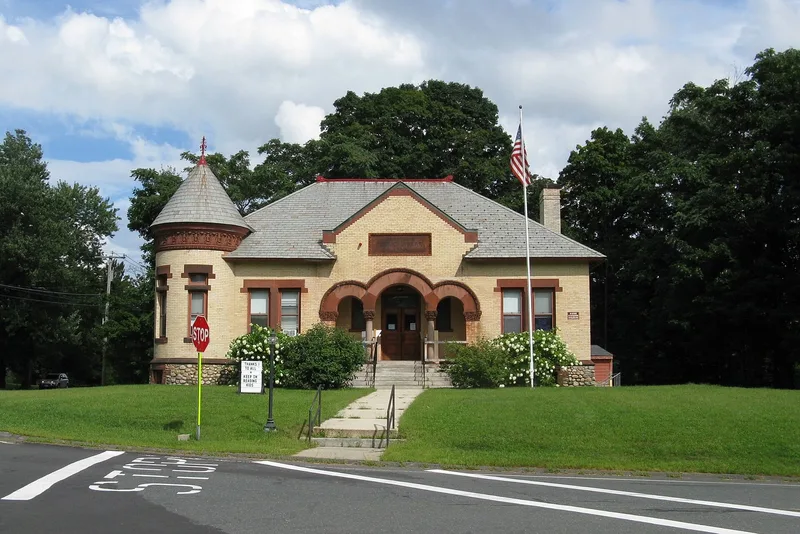
Granville Village, also called East Granville or Jockey Corners, is a half-mile stretch of Massachusetts Route 57 lined with old maple trees. It is mostly residential, with 19th-century clapboard houses of modest ornament, along with a library, a Grange hall, a parsonage and a drum factory. The district includes a triangular common at the meeting of Granby Road and Maple Street. Its growth followed the drum trade. Noble and Cooley began making drums in 1854, and the company later moved to Water Street beside Dickinson Brook. Its surviving buildings have been used continuously. Workers lived in small Greek Revival houses along Main Road, and the Civil War boom brought merchants who built Italianate, Queen Anne and Colonial Revival homes on Maple Street. Other landmarks include the 1850 academy building, later a Baptist parsonage, the 1890 Grange and the 1901 Romanesque Revival public library. A few early houses, dating from 1804 to about 1820, record the village's beginnings as a small crossroads.
Significance in brief: The village grew around drum manufacturing, which began with the Noble and Cooley Drum Company in 1854 and shaped its housing, civic buildings and prosperity. It also preserves early Baptist church history, a privately founded co-educational academy, and a well-kept range of Georgian, Federal, Greek Revival, Italianate, Queen Anne and Romanesque Revival architecture.
Machine-generated summary. This summary was generated by a language model from the official nomination document and has not been reviewed line by line by an editor. It may contain errors. Check the source document before relying on any detail. Source: nomination document (PDF) · National Archives catalog entry. NRHP reference 91001588, listed November 5, 1991. Summary generated October 2026 (model claude-sonnet-5-5, prompt v1.0-2026-10-29, confidence medium).
Key facts
| Address | Roughly, area around jct. of Maple St. and Main and Granby Rds., including part of Water St., Granville |
|---|---|
| County | Hampden County |
| Listed | November 5, 1991 |
| Reference number | 91001588 |
| Resource type | District |
| Architectural style | Colonial/Georgian; Early Republic/Federal; Greek Revival; Italianate; Queen Anne; Romanesque; Colonial Revival; No Style |
| Areas of significance | Industry, Community Planning and Development, Architecture |
| Level of significance | Local |
| Status (as stated in the nomination) | The Noble and Cooley drum factory buildings on Water Street have been in continuous use. The Baptist meetinghouse was moved and altered into a non-contributing residence, and the Wilcox Hotel was demolished around 1920. |
| Acreage | 59 |
| Coordinates | 42.06517, -72.86449 (NPS GIS) |
What listing means for this property
This is a historic district. Buildings within its boundary are either contributing (they add to the district's significance) or non-contributing. Owners of contributing income-producing buildings can claim the 20% federal rehabilitation tax credit; homeowners should look at state credits. National Register districts impose no design review by themselves; a local historic district ordinance, if one exists, does (the difference explained).
General information, not legal or tax advice. Rules change; confirm with your State Historic Preservation Office or a qualified adviser.
Sources and further reading
- National Park Service, National Register of Historic Places database (snapshot May 2026), reference 91001588.
- Nomination form (PDF, National Archives) — catalog entry
- Wikipedia article (used for cross-checking only; text not reproduced here)
- Wikidata Q5596969
- This listing as JSON
Last updated October 2026. Found an error? See the editorial policy for how to report it.