Granville Center Historic District

Why it's listed
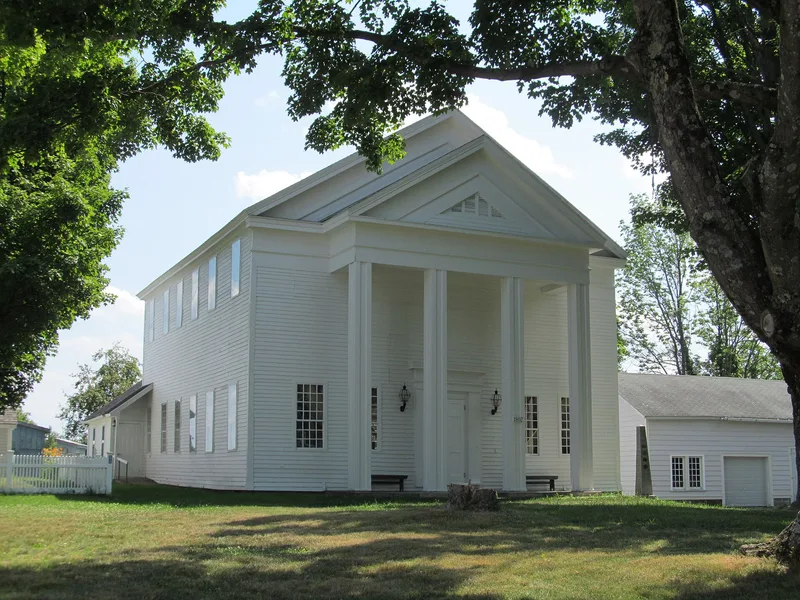
Granville Center, known locally as "The Hill," is a half-mile stretch of Main Road (Route 57) at the geographic center of Granville, Massachusetts. Wood-frame houses with clapboard siding, brick chimneys and stone foundations sit close together beneath tall maples. Federal-style buildings dominate, including the L. Hubbard, Israel Parsons "1800 House" and Joel Root houses, which feature colossal pilasters and Palladian windows. Smaller groups of Greek Revival houses and single Gothic Revival and Queen Anne examples add variety. The 1802 First Church of Christ Congregational was served for decades by Dr. Timothy Mather Cooley. In the early nineteenth century the Center held a lawyer, a doctor, a store and a church. Commerce and industry shifted east to Granville Village by the mid-1800s, partly because of the drum factory's move in 1857. The Center stayed the seat of town government, and a Town Hall was built there in 1927.
Significance in brief: The district contains some of the town's most ambitious Federal-style architecture, together with Greek Revival, Gothic Revival and Queen Anne examples. It was the religious, commercial and political center of Granville in the early nineteenth century. It remains the seat of town government, with the Town Hall built in 1927.
Machine-generated summary. This summary was generated by a language model from the official nomination document and has not been reviewed line by line by an editor. It may contain errors. Check the source document before relying on any detail. Source: nomination document (PDF) · National Archives catalog entry. NRHP reference 91001587, listed November 5, 1991. Summary generated October 2026 (model claude-sonnet-5-5, prompt v1.0-2026-10-29, confidence medium).
Key facts
| Address | Main Rd., Granville |
|---|---|
| County | Hampden County |
| Listed | November 5, 1991 |
| Reference number | 91001587 |
| Resource type | District |
| Architectural style | Early Republic/Federal; Mid-19th Century/Greek Revival; Gothic Revival; Late Victorian/Queen Anne; Late 19th Century Revivals/Colonial Revival |
| Areas of significance | Community Planning and Development, Politics/Government, Architecture |
| Level of significance | Local |
| Status (as stated in the nomination) | Several former commercial and institutional buildings, including the General Store and the Sabbath Day House, now serve as residences. The Town Hall and the church remain in public and religious use. |
| Acreage | 30 |
| Coordinates | 42.06695, -72.87528 (NPS GIS) |
What listing means for this property
This is a historic district. Buildings within its boundary are either contributing (they add to the district's significance) or non-contributing. Owners of contributing income-producing buildings can claim the 20% federal rehabilitation tax credit; homeowners should look at state credits. National Register districts impose no design review by themselves; a local historic district ordinance, if one exists, does (the difference explained).
General information, not legal or tax advice. Rules change; confirm with your State Historic Preservation Office or a qualified adviser.
Sources and further reading
- National Park Service, National Register of Historic Places database (snapshot May 2026), reference 91001587.
- Nomination form (PDF, National Archives) — catalog entry
- Wikipedia article (used for cross-checking only; text not reproduced here)
- Wikidata Q5596871
- This listing as JSON
Last updated October 2026. Found an error? See the editorial policy for how to report it.