Shawsheen Village Historic District

Why it's listed
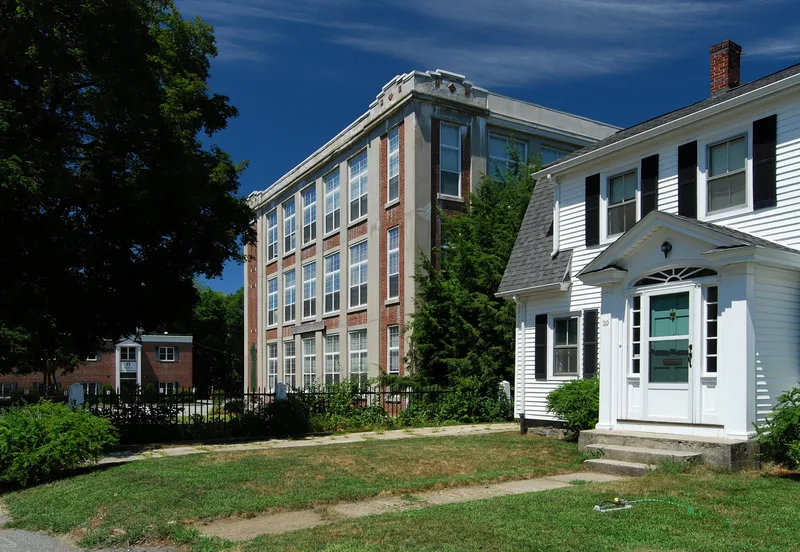
Shawsheen Village is a planned community in northern Andover, Massachusetts, laid out on about 600 acres along the Shawsheen River. William M. Wood, president of the American Woolen Company, bought the land in 1918 and the company built the village between 1919 and 1924. It absorbed the small settlement of Frye Village, whose mills were demolished while most existing houses and streets were kept. The village has three main parts: brick houses for senior executives west of the river, a central area of shops, offices and manufacturing, and smaller frame houses for middle-level office workers. More than two hundred homes were built, along with an administration building, post office, school, restaurant, creamery, community garages, power plant and brush mill. Georgian Revival design predominates. The district is described as a self-sufficient company town, and many of its buildings, including the 1924 Shawsheen School, remain in use.
Significance in brief: The nomination presents it as a fully planned, self-sustaining community for company executives and office workers, laid out with housing, commercial, civic and recreational facilities. It absorbed the earlier Frye Village and retained its street system. Its buildings are largely in the Georgian Revival style.
Machine-generated summary. This summary was generated by a language model from the official nomination document and has not been reviewed line by line by an editor. It may contain errors. Check the source document before relying on any detail. Source: nomination document (PDF) · National Archives catalog entry. NRHP reference 79000328, listed February 9, 1979. Summary generated October 2026 (model claude-sonnet-5-5, prompt v1.0-2026-10-29, confidence medium).
Key facts
| Address | MA 133, Andover |
|---|---|
| County | Essex County |
| Listed | February 9, 1979 |
| Reference number | 79000328 |
| Resource type | District |
| Architect / builder | Architects named for individual buildings include Reps and Boutiller (Shawsheen School), Adden and Parker (Community Garage), W.B. Knowlton (Creamery) and R.R. Slater (Brush Mill). |
| Architectural style | Georgian Revival predominates in the Village |
| Areas of significance | Industry, Community Planning and Development, Commerce, Architecture |
| Level of significance | State |
| Status (as stated in the nomination) | Condition listed as excellent to good and altered; occupied, with private residences, industrial and other uses. The Merchants' Building was converted to apartments and the school remains in public use. |
| Acreage | 152 |
| Coordinates | 42.67213, -71.14662 (NPS GIS) |
What listing means for this property
This is a historic district. Buildings within its boundary are either contributing (they add to the district's significance) or non-contributing. Owners of contributing income-producing buildings can claim the 20% federal rehabilitation tax credit; homeowners should look at state credits. National Register districts impose no design review by themselves; a local historic district ordinance, if one exists, does (the difference explained).
General information, not legal or tax advice. Rules change; confirm with your State Historic Preservation Office or a qualified adviser.
Sources and further reading
- National Park Service, National Register of Historic Places database (snapshot May 2026), reference 79000328.
- Nomination form (PDF, National Archives) — catalog entry
- Wikipedia article (used for cross-checking only; text not reproduced here)
- Wikidata Q7491593
- This listing as JSON
Last updated October 2026. Found an error? See the editorial policy for how to report it.