High Street Historic District

Why it's listed
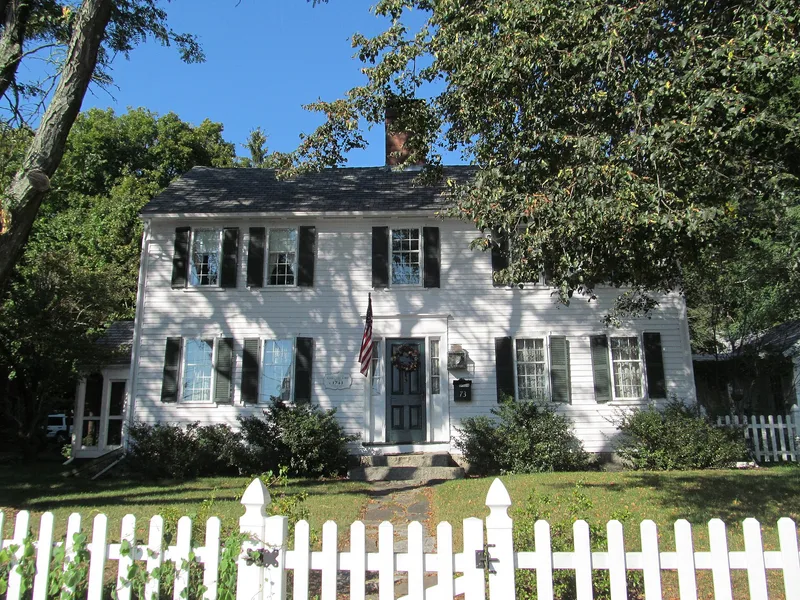
High Street in Ipswich, Massachusetts, dates to the town's founding in 1633 and served as its main residential and commercial street. The historic district covers about 26 acres running along the side of Town Hill and includes the 1634 Burial Ground with its 17th and 18th century slate gravestones. Most of the key buildings are two-story, end-gable, timber or wood-frame clapboarded houses, with dates ranging from the 1630s-1650s to the 1800s and a Queen Anne house of the 1880s-90s. Many once housed taverns, stores and craftsmen's shops, including cabinetmakers, and two ordinaries, the White Horse Inn and the Perkins Inn, operated here by the mid-17th century. In 1832 Benjamin Fewkes worked on the first stocking frames built in the United States in a shop behind a High Street house, beginning the town's hosiery industry. After Central Street opened in 1871, traffic shifted and High Street became purely residential. The result is a harmonious streetscape with an 18th century quality.
Significance in brief: High Street was the main residential and commercial street of Ipswich from its founding, and many houses once served as taverns, stores or craftsmen's shops. It was the site of the first stocking frames built in the United States in 1832, which began the town's hosiery industry. The street keeps a harmonious streetscape of 17th and 18th century homes, including several First Period houses.
Machine-generated summary. This summary was generated by a language model from the official nomination document and has not been reviewed line by line by an editor. It may contain errors. Check the source document before relying on any detail. Source: nomination document (PDF) · National Archives catalog entry. NRHP reference 80000454, listed September 17, 1980. Summary generated October 2026 (model claude-sonnet-5-5, prompt v1.0-2026-10-29, confidence medium).
Key facts
| Address | High St., Ipswich |
|---|---|
| County | Essex County |
| Listed | September 17, 1980 |
| Reference number | 80000454 |
| Resource type | District |
| Architectural style | Mixed: Colonial, Georgian, Federal, Greek Revival, Queen Anne and other 19th century styles |
| Areas of significance | Exploration/Settlement, Architecture |
| Level of significance | National, State |
| Status (as stated in the nomination) | Area is described as well maintained, in private ownership and in residential use. |
| Acreage | 26 |
| Coordinates | 42.68511, -70.84195 (NPS GIS) |
What listing means for this property
This is a historic district. Buildings within its boundary are either contributing (they add to the district's significance) or non-contributing. Owners of contributing income-producing buildings can claim the 20% federal rehabilitation tax credit; homeowners should look at state credits. National Register districts impose no design review by themselves; a local historic district ordinance, if one exists, does (the difference explained).
General information, not legal or tax advice. Rules change; confirm with your State Historic Preservation Office or a qualified adviser.
Sources and further reading
- National Park Service, National Register of Historic Places database (snapshot May 2026), reference 80000454.
- Nomination form (PDF, National Archives) — catalog entry
- Wikipedia article (used for cross-checking only; text not reproduced here)
- Wikidata Q14715534
- This listing as JSON
Last updated October 2026. Found an error? See the editorial policy for how to report it.