East Parish Meeting House
Also known as: Fourth Congregational Church
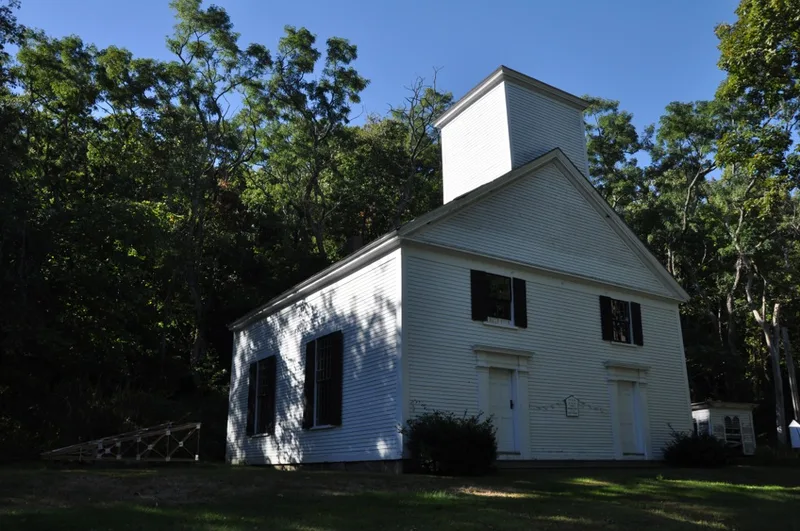

Why it's listed
Built in 1838 on Middle Road in eastern Haverhill, this small clapboarded meetinghouse replaced an earlier 1744 building on the same site. Its front-gabled form, plain triangular pediment, wide corner boards and twin pilastered front doors reflect the Greek Revival style, while the double entry follows the parish practice of separate seating for men and women. Inside, a concave lobby, gallery, pews and a pot-bellied stove survive, and the sanctuary has no running water, furnace or electrical outlets. A bell cast by G.H. Holbrook in 1848 was first installed in Haverhill Town Hall and moved here in 1861. The belfry and bell have been in storage since 2006 because the tower proved unstable. The building is valued as a well-preserved rural example of Greek Revival church design and for its link to the landscape of poet John Greenleaf Whittier. A neighborhood association owns and maintains it.
Significance in brief: The nomination argues it is a remarkably unaltered rural meetinghouse and a well-preserved example of Greek Revival ecclesiastical architecture. It is also noted for its 1848 George Holbrook bell and for its place in the literary landscape of poet John Greenleaf Whittier's 'Whittierland'.
Machine-generated summary. This summary was generated by a language model from the official nomination document and has not been reviewed line by line by an editor. It may contain errors. Check the source document before relying on any detail. Source: nomination document (PDF) · National Archives catalog entry. NRHP reference 11000149, listed March 29, 2011. Summary generated October 2026 (model claude-sonnet-5-5, prompt v1.0-2026-10-29, confidence medium).
Key facts
| Address | 150 Middle Rd. (formerly 267), Haverhill |
|---|---|
| County | Essex County |
| Listed | March 29, 2011 |
| Reference number | 11000149 |
| Resource type | Building |
| Period of significance | 1838-1960 |
| Architectural style | Mid 19th Century Revivals: Greek Revival, Gothic Revival |
| Criteria |
|
| Areas of significance | Architecture, Community Planning and Development, Religion |
| Level of significance | Local |
| Status (as stated in the nomination) | Described as in good condition and owned by a volunteer neighborhood association; the belfry, steeple and bell were removed and stored offsite in 2006 because the tower was unstable, and restoration is being sought. |
| Acreage | 0.9 |
| Coordinates | 42.79273, -71.02333 (NPS GIS) |
What listing means for this property
Religious properties are listed for their architectural or historical significance, not their religious use. Listing is honorary and does not restrict the congregation's use of the building. The federal rehabilitation credit is generally unavailable unless part of the building is income-producing; some state programmes and preservation grants do cover religious buildings. Federal funding or permits trigger Section 106 review.
General information, not legal or tax advice. Rules change; confirm with your State Historic Preservation Office or a qualified adviser.
Sources and further reading
- National Park Service, National Register of Historic Places database (snapshot May 2026), reference 11000149.
- Nomination form (PDF, National Archives) — catalog entry
- Wikipedia article (used for cross-checking only; text not reproduced here)
- Wikidata Q16890820
- This listing as JSON
Last updated October 2026. Found an error? See the editorial policy for how to report it.