Chaplin-Clarke House
Also known as: state survey no.:37

Why it's listed
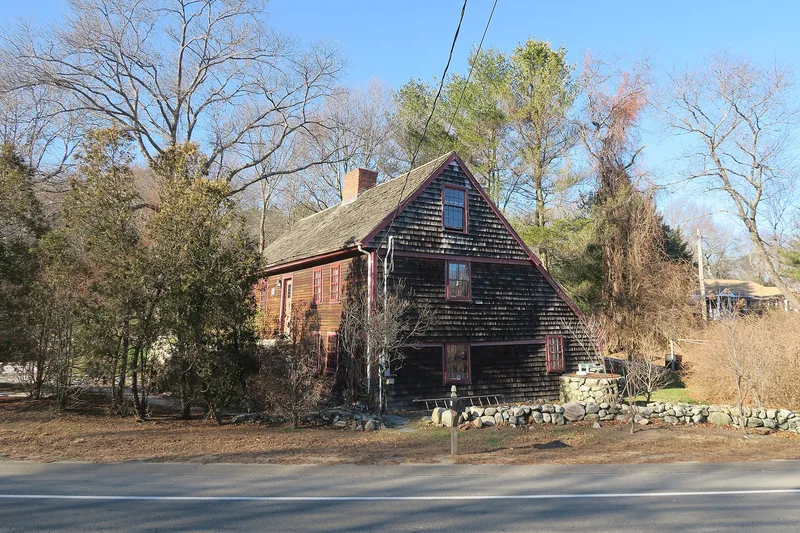
Built into a hillside southwest of Rowley Center, this house at 109 Haverhill Street is regarded as the oldest in town. Joseph Chaplin erected a one-room-deep house around 1670, probably on the site of a simpler structure raised by his father Hugh Chaplin in 1643. A lean-to added about 1700 completed the present form. The house faces south, with a western half of 1½ stories and an eastern half of 2½ stories. The facade is clapboarded, the sides are shingled, and a central chimney anchors the plan. Decoration is minimal. Inside are three large fireplaces, chamfered structural members and some original sheathing and hardware. Richard Clarke acquired the property early in the eighteenth century, and the Society for the Preservation of New England Antiquities later owned it before it returned to private hands. It is considered the last vestige of Rowley's original settlement, and the grounds may also yield archeological evidence of early construction methods.
Significance in brief: The nomination calls it the oldest house in Rowley and an unusual, well-preserved example of seventeenth-century construction. It is described as the last vestige of Rowley's original settlement. The surrounding area may also hold archeological information on early construction techniques, lifeways and 17th-century coastal adaptations.
Machine-generated summary. This summary was generated by a language model from the official nomination document and has not been reviewed line by line by an editor. It may contain errors. Check the source document before relying on any detail. Source: nomination document (PDF) · National Archives catalog entry. NRHP reference 79000343, listed May 10, 1979. Summary generated October 2026 (model claude-sonnet-5-5, prompt v1.0-2026-10-29, confidence high).
Key facts
| Address | 109 Haverhill St., Rowley |
|---|---|
| County | Essex County |
| Listed | May 10, 1979 |
| Reference number | 79000343 |
| Resource type | Building |
| Period of significance | 1670, 1700 |
| Architect / builder | Joseph Chaplin |
| Areas of significance | Exploration/Settlement, Architecture |
| Level of significance | Local |
| Status (as stated in the nomination) | Returned to private ownership after earlier ownership by the Society for the Preservation of New England Antiquities; the form lists it as occupied private residence. |
| Acreage | 5 |
| Coordinates | 42.70935, -70.89167 (NPS GIS) |
What listing means for this property
National Register listing is honorary for a privately owned home: it does not by itself restrict what an owner may do with their own money, and it does not require public access. Restrictions come from local landmark or historic-district ordinances, which are separate (how they differ).
Owner-occupied houses are not eligible for the 20% federal rehabilitation tax credit, which applies to income-producing buildings, but many states offer credits for homeowners. Listing also opens the door to preservation easements and to buying a plaque. Start with what listing means for homeowners, renovating a listed house and selling one.
General information, not legal or tax advice. Rules change; confirm with your State Historic Preservation Office or a qualified adviser.
Sources and further reading
- National Park Service, National Register of Historic Places database (snapshot May 2026), reference 79000343.
- Nomination form (PDF, National Archives) — catalog entry
- Wikipedia article (used for cross-checking only; text not reproduced here)
- Wikidata Q5073221
- This listing as JSON
Last updated October 2026. Found an error? See the editorial policy for how to report it.