Winslow Congregational Church

Why it's listed
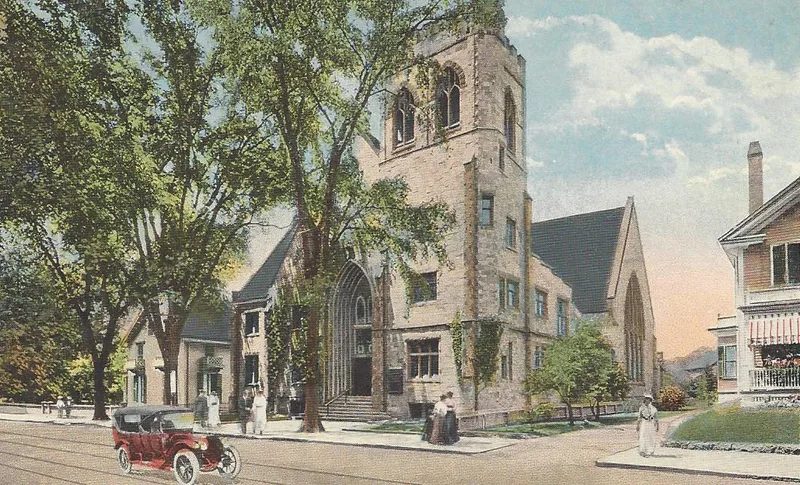
Built in 1897 and dedicated the next year, this Victorian Gothic church at 61 Winthrop Street in Taunton was constructed for the Winslow Congregational Church. It has two levels, an irregular plan of intersecting gabled sections, and an engaged four-level corner tower with a parapeted belfry. The main entrance sits in a compound pointed arch beneath a tympanum of stained glass and wood. Uncoursed sandstone walls contrast with brownstone trim on windows, coping and parapets, and tall stained glass windows are set in hood molds. The congregation grew from a group of members who left the Broadway and Westville churches in the 1830s. It built a meeting house on Cohannet Street in 1853, named for Governor Edward Winslow, and raised funds for the present building as membership rose after the Civil War. The property is valued mainly for its architecture and secondarily as evidence of the growth of Taunton's largest religious group. It is now home to the Church of All Nations.
Significance in brief: The nomination argues the church is among the most impressive of Taunton's 19th-century churches, with sandstone construction and bold Gothic detailing. It also represents the growth of Taunton's largest religious group, the Congregationalists. Architecture is the primary significance and history the secondary one.
Machine-generated summary. This summary was generated by a language model from the official nomination document and has not been reviewed line by line by an editor. It may contain errors. Check the source document before relying on any detail. Source: nomination document (PDF) · National Archives catalog entry. NRHP reference 84002288, listed July 5, 1984. Summary generated October 2026 (model claude-sonnet-5-5, prompt v1.0-2026-10-29, confidence medium).
Key facts
| Address | 61 Winthrop St., Taunton |
|---|---|
| County | Bristol County |
| Listed | July 5, 1984 |
| Reference number | 84002288 |
| Resource type | Building |
| Architectural style | Victorian Gothic |
| Criteria |
|
| Areas of significance | Architecture, Religion |
| Level of significance | Local |
| Status (as stated in the nomination) | Still a church, now known as the Church of All Nations; the form reports no alterations or moves and says it retains integrity. |
| Acreage | 0.9 |
| Coordinates | 41.89878, -71.09670 (NPS GIS) |
What listing means for this property
Religious properties are listed for their architectural or historical significance, not their religious use. Listing is honorary and does not restrict the congregation's use of the building. The federal rehabilitation credit is generally unavailable unless part of the building is income-producing; some state programmes and preservation grants do cover religious buildings. Federal funding or permits trigger Section 106 review.
General information, not legal or tax advice. Rules change; confirm with your State Historic Preservation Office or a qualified adviser.
Sources and further reading
- National Park Service, National Register of Historic Places database (snapshot May 2026), reference 84002288.
- Nomination form (PDF, National Archives) — catalog entry
- Wikipedia article (used for cross-checking only; text not reproduced here)
- Wikidata Q8025944
- This listing as JSON
Last updated October 2026. Found an error? See the editorial policy for how to report it.