Sagamore Mills No. 1 and No. 3

Why it's listed
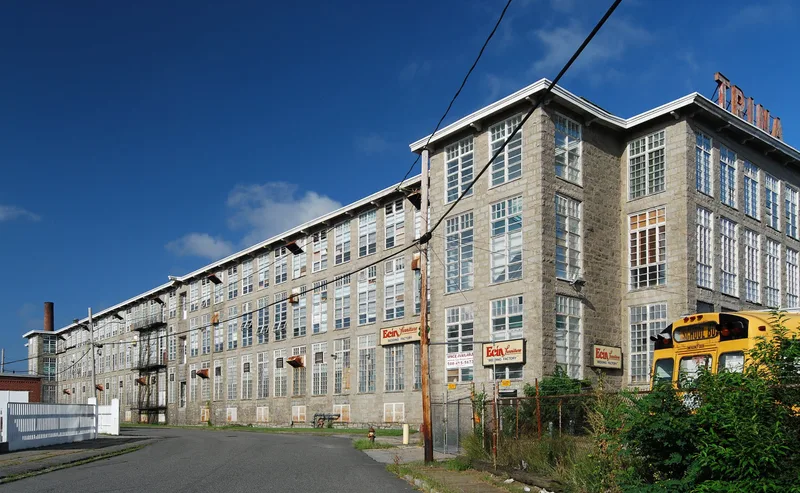
Sagamore Mills is a large textile complex on a 35-acre site in northern Fall River, near the Taunton River. It includes two granite mills and one brick mill, along with more than a dozen auxiliary buildings scattered across the grounds. The first mill, designed by D. H. Dyer in 1872, burned in 1884. A granite mill followed in 1881, built with stone brought by spur track from a new quarry in Assonet. Mill #1 was rebuilt in brick in 1888 in the Romanesque style, with arched windows and a central stair tower. A third granite mill was added in 1907, and its large window area reflects its later date. The Sagamore company grew to over 150,000 spindles by 1920, outlasted the Great Depression, and operated into the 1960s. The mills retain bracketed wooden cornices and most original sash. The complex was listed for its representation of late industrial architecture and for the company's importance in Fall River textile manufacturing. The buildings remain in industrial use.
Significance in brief: The complex is argued to be significant as an example of late industrial architecture in Fall River and as one of the city's largest textile companies of its period, surviving into the 1960s. The form says it meets criteria A and C.
Machine-generated summary. This summary was generated by a language model from the official nomination document and has not been reviewed line by line by an editor. It may contain errors. Check the source document before relying on any detail. Source: nomination document (PDF) · National Archives catalog entry. NRHP reference 83000713, listed February 16, 1983. Summary generated October 2026 (model claude-sonnet-5-5, prompt v1.0-2026-10-29, confidence high).
Key facts
| Address | Ace St., Fall River |
|---|---|
| County | Bristol County |
| Listed | February 16, 1983 |
| Reference number | 83000713 |
| Resource type | Building |
| Period of significance | 1881-1907 |
| Architect / builder | D. H. Dyer (designer of the original 1872 mill) |
| Architectural style | Romanesque (brick Mill #1); utilitarian granite mill style |
| Criteria |
|
| Areas of significance | Industry, Architecture |
| Level of significance | State |
| Status (as stated in the nomination) | Properties were sold in 1965 to different owners and remain in industrial use. |
| Acreage | 17.2 |
| Coordinates | 41.72609, -71.14476 (NPS GIS) |
What listing means for this property
National Register listing is honorary: it recognises significance and does not restrict what a private owner may do without federal money or permits. It unlocks the 20% federal rehabilitation tax credit for income-producing buildings, state credits in many states, and Section 106 review when federal agencies are involved. See what listing means in practice.
General information, not legal or tax advice. Rules change; confirm with your State Historic Preservation Office or a qualified adviser.
Sources and further reading
- National Park Service, National Register of Historic Places database (snapshot May 2026), reference 83000713.
- Nomination form (PDF, National Archives) — catalog entry
- Wikipedia article (used for cross-checking only; text not reproduced here)
- Wikidata Q7398981
- This listing as JSON
Last updated October 2026. Found an error? See the editorial policy for how to report it.