Norton Center Historic District

Why it's listed
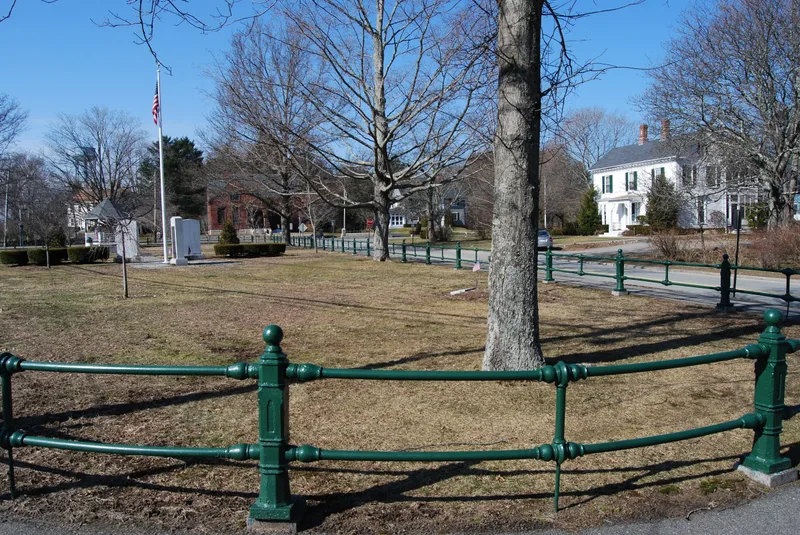
Norton Center is a village core of sixty-four buildings gathered around Library Square, East Main Street and the Wheaton College campus. Mostly residential, it also holds the Town Hall, Public Library, Post Office, two churches and college buildings. Lawns, large trees and open space give it a rural New England feel. The Old Parsonage, built in 1710 as the home of the town's first minister, is the oldest building in Norton; its saltbox outline appears on the town seal. Wheaton Seminary, founded in 1834, shaped the area's growth, and the Wheaton family funded the 1888 Public Library, designed by Stephen C. Earle in the Romanesque Revival style. Other notable buildings include the Federal-style President's House of 1839, the Greek Revival and Gothic Unitarian Church of 1835, and Ralph Adams Cram's Colonial Revival Cole Memorial Chapel of 1917. More than three-quarters of the buildings predate 1900, giving the district a cohesive architectural character.
Significance in brief: The district is significant for its associations with the development of Norton and as an architecturally unified, cohesive area. Over seventy-five percent of its buildings predate 1900. It holds the town's oldest building, the 1710 Old Parsonage, plus Wheaton College, two historic churches, and civic buildings funded by the locally prominent Wheaton family.
Machine-generated summary. This summary was generated by a language model from the official nomination document and has not been reviewed line by line by an editor. It may contain errors. Check the source document before relying on any detail. Source: nomination document (PDF) · National Archives catalog entry. NRHP reference 77000170, listed December 23, 1977. Summary generated October 2026 (model claude-sonnet-5-5, prompt v1.0-2026-10-29, confidence medium).
Key facts
| Address | MA 123, Norton |
|---|---|
| County | Bristol County |
| Listed | December 23, 1977 |
| Reference number | 77000170 |
| Resource type | District |
| Architect / builder | Stephen C. Earle of Worcester (Public Library); Ralph Adams Cram (Cole Memorial Chapel); Fred Brock of Cambridge (1963 Trinitarian Church addition) |
| Architectural style | Greek Revival, Federal, Italianate, Queen Anne, Romanesque Revival and Colonial Revival |
| Areas of significance | Education, Exploration/Settlement, Architecture |
| Level of significance | Local |
| Status (as stated in the nomination) | Marked as occupied; the form says all buildings are well maintained and the area has few commercial intrusions. |
| Acreage | 50 |
| Coordinates | 41.96797, -71.18642 (NPS GIS) |
What listing means for this property
This is a historic district. Buildings within its boundary are either contributing (they add to the district's significance) or non-contributing. Owners of contributing income-producing buildings can claim the 20% federal rehabilitation tax credit; homeowners should look at state credits. National Register districts impose no design review by themselves; a local historic district ordinance, if one exists, does (the difference explained).
General information, not legal or tax advice. Rules change; confirm with your State Historic Preservation Office or a qualified adviser.
Sources and further reading
- National Park Service, National Register of Historic Places database (snapshot May 2026), reference 77000170.
- Nomination form (PDF, National Archives) — catalog entry
- Wikipedia article (used for cross-checking only; text not reproduced here)
- Wikidata Q7060598
- This listing as JSON
Last updated October 2026. Found an error? See the editorial policy for how to report it.