Lee Lower Main Street Historic District

Why it's listed
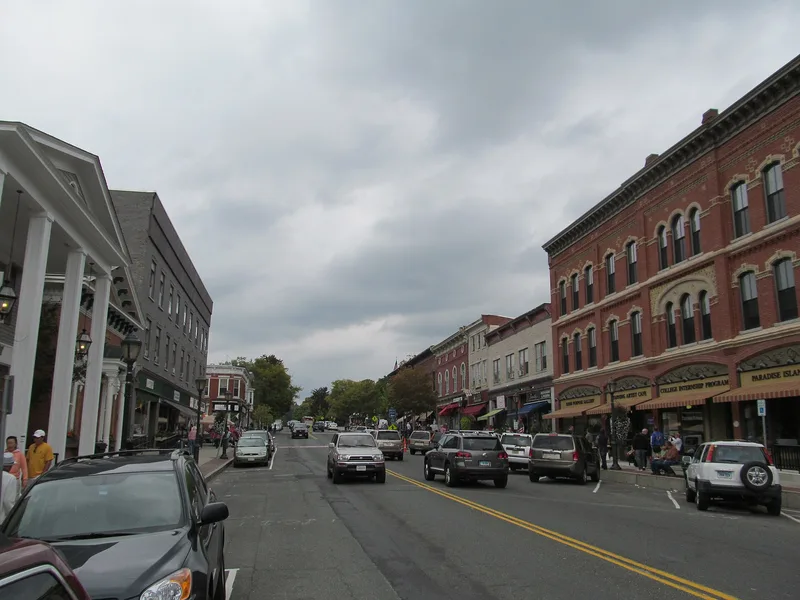
Lee's lower Main Street district covers about 15 acres at the center of town and includes 18 buildings and an oval park. Commercial blocks dominate the north end, while homes, government buildings and a church occupy the south end. Styles include Italianate, Renaissance Revival and French Mansard, with Federal, Romanesque Revival and Shingle Style examples as well. Key landmarks are the 1858 First Congregational Church, Memorial Hall of 1874 (a Civil War memorial that serves as town hall and courthouse), the c. 1835 Lee National Bank and the 1907 marble Lee Library. The park holds a marble-posted fence and a fountain designed by Daniel Chester French. The district was listed because it preserves a 19th-century town center and reflects two industries. Lee marble, used in the U.S. Capitol and other major buildings, shaped local construction. Paper manufacturing made Lee a leading producer by 1857, and mill families financed blocks such as the Baird and Benton Blocks.
Significance in brief: The district is a well-preserved 19th-century town center with a wide range of architectural styles from the 19th and early 20th centuries. It is also tied to the growth of the paper-making and marble industries in the United States. Lee marble shaped the look of its buildings, and paper manufacturers invested in its business blocks.
Machine-generated summary. This summary was generated by a language model from the official nomination document and has not been reviewed line by line by an editor. It may contain errors. Check the source document before relying on any detail. Source: nomination document (PDF) · National Archives catalog entry. NRHP reference 09000090, listed March 26, 1976. Summary generated October 2026 (model claude-sonnet-5-5, prompt v1.0-2026-10-29, confidence high).
Key facts
| Address | Roughly, area surrounding Main and Park Streets, Lee |
|---|---|
| County | Berkshire County |
| Listed | March 26, 1976 |
| Reference number | 09000090 |
| Resource type | District |
| Period of significance | 1800-1899, 1900- |
| Architect / builder | A. L. Clark of Pittsfield (First Congregational Church); G. A. Day (1965 church addition); Daniel Chester French (1899 fountain design); Dante Baccolini (stonecutter, fountain) |
| Architectural style | Italianate, Renaissance Revival and French Mansard, with Federal, Romanesque Revival, Shingle Style and Classical Revival examples |
| Areas of significance | Architecture, Commerce, Industry, Religion |
| Level of significance | Local |
| Status (as stated in the nomination) | Rated in good condition and occupied. Some storefronts have been altered at street level with modern signs and display windows, but the form describes the changes as reversible. |
| Acreage | 15 |
| Coordinates | 42.30493, -73.24870 (NPS GIS) |
What listing means for this property
This is a historic district. Buildings within its boundary are either contributing (they add to the district's significance) or non-contributing. Owners of contributing income-producing buildings can claim the 20% federal rehabilitation tax credit; homeowners should look at state credits. National Register districts impose no design review by themselves; a local historic district ordinance, if one exists, does (the difference explained).
General information, not legal or tax advice. Rules change; confirm with your State Historic Preservation Office or a qualified adviser.
Sources and further reading
- National Park Service, National Register of Historic Places database (snapshot May 2026), reference 09000090.
- Nomination form (PDF, National Archives) — catalog entry
- Wikipedia article (used for cross-checking only; text not reproduced here)
- Wikidata Q16931421
- This listing as JSON
Last updated October 2026. Found an error? See the editorial policy for how to report it.