Harwich Historic District
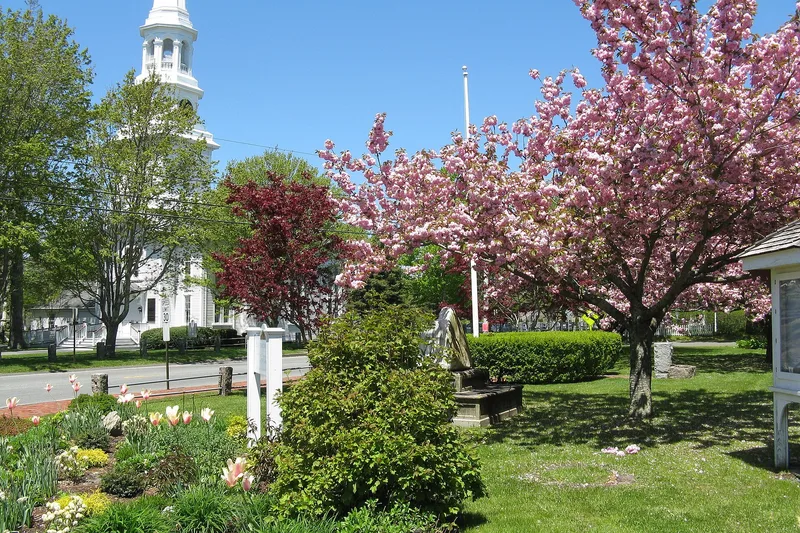

Why it's listed
Harwich's town center forms a 55-acre district of 55 buildings arranged along Main Street and its parallel and side streets. Narrow streets, trees and open spaces give it a semi-rural feel. Greek Revival and Italianate buildings predominate, with some Lombard Romanesque and Colonial Revival examples, and a few modest modern structures such as a pharmacy, telephone building and gas station. Notable buildings include the First Congregational Church, remodeled in 1854, the 1836 Dr. Franklin Dodge House, the 1844 Brooks Academy, the Brooks Block and the former Bank Building, which together form the Brooks Free Library, and several 1860s shops. The district was listed because it preserves the 19th-century look of the town's historic center and because so many buildings and parks came from the Broadbrooks, later Brooks, family. Family members founded a navigation school, and gave the library, a parsonage and Brooks Park to the town or church. The First Congregational Church also took a public abolitionist stand in 1846.
Significance in brief: The district is significant for its fine Greek Revival and Italianate architecture and as the center of the town's historic development. It keeps its 19th-century architectural and spatial character despite a few modest modern buildings. Many of its buildings are tied to the Broadbrooks (later Brooks) family, the town's most important philanthropic family.
Machine-generated summary. This summary was generated by a language model from the official nomination document and has not been reviewed line by line by an editor. It may contain errors. Check the source document before relying on any detail. Source: nomination document (PDF) · National Archives catalog entry. NRHP reference 75000245, listed February 24, 1975. Summary generated October 2026 (model claude-sonnet-5-5, prompt v1.0-2026-10-29, confidence medium).
Key facts
| Address | Irregular pattern on both sides of Main St., W to Forest St. and E to jct. of Rte. 39 and Chatham Rd., Harwich |
|---|---|
| County | Barnstable County |
| Listed | February 24, 1975 |
| Reference number | 75000245 |
| Resource type | District |
| Period of significance | 18th and 19th centuries (checked on form; no specific dates given) |
| Architect / builder | Calvin Gifford (designed the Old Broadbrooks House and his own house); Luther Gifford (Dr. Franklin Dodge House, Bank Building); J.D. Towle of Towle and Foster (1854 remodeling of First Congregational Church) |
| Architectural style | Predominantly Greek Revival and Italianate, with some Lombard Romanesque and Colonial Revival |
| Areas of significance | Architecture, Social History |
| Level of significance | State |
| Status (as stated in the nomination) | Condition listed as good, mostly unaltered and on original sites. The district became a local historic district in 1973. |
| Acreage | 55 |
| Coordinates | 41.68633, -70.07299 (NPS GIS) |
What listing means for this property
This is a historic district. Buildings within its boundary are either contributing (they add to the district's significance) or non-contributing. Owners of contributing income-producing buildings can claim the 20% federal rehabilitation tax credit; homeowners should look at state credits. National Register districts impose no design review by themselves; a local historic district ordinance, if one exists, does (the difference explained).
General information, not legal or tax advice. Rules change; confirm with your State Historic Preservation Office or a qualified adviser.
Sources and further reading
- National Park Service, National Register of Historic Places database (snapshot May 2026), reference 75000245.
- Nomination form (PDF, National Archives) — catalog entry
- Wikipedia article (used for cross-checking only; text not reproduced here)
- Wikidata Q5677849
- This listing as JSON
Last updated October 2026. Found an error? See the editorial policy for how to report it.