Rockton Historic District

The pin is a point inside the NPS boundary polygon, not a surveyed location.
Why it's listed
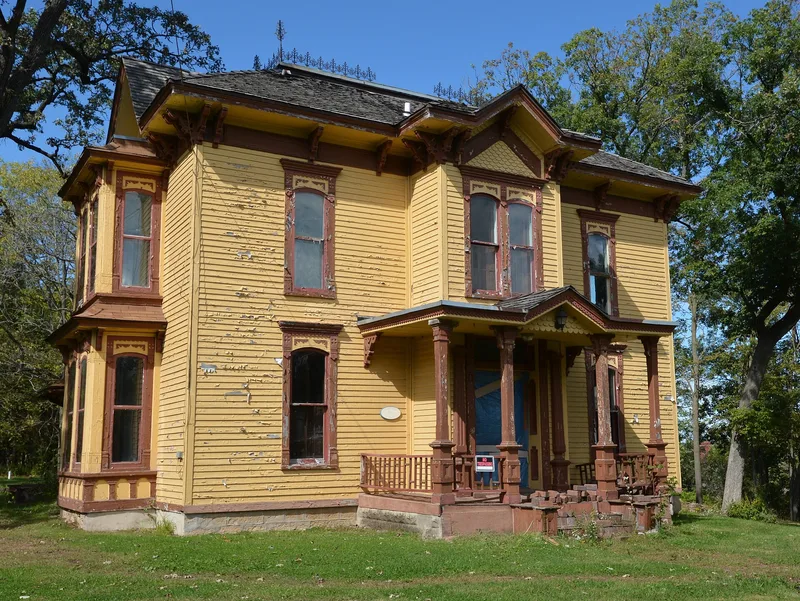
Rockton's historic district takes in most of the village on both sides of the Rock River in Winnebago County, Illinois. Settlement began in 1835 under William Talcott and his sons, who dug a mill race in 1838 and built early sawmills, grist mills, paper mills and reaper works. Settlers came largely from upstate New York and New England, and they built sophisticated houses rather than log cabins. The district holds about 208 structures, and 51 are Greek Revival, dating from the late 1830s to 1855. Examples include the Henry Talcott House, the First Congregational Church and the Martin Ormsby House. Rockton did not prosper during the Civil War. Railroads bypassed the town, fires destroyed the mill buildings, and residents moved to Rockford and Beloit. That stagnation preserved the early houses. The boundary leaves out most of the remodeled commercial center on Main Street. Most buildings remain single-family homes, though newer construction accounts for about one fifth of the structures.
Significance in brief: Rockton is one of the earliest settlements in far north-central Illinois, and its founders were the first to harness the Rock River for industry. Its more than 50 surviving Greek Revival buildings make it one of the largest and most significant concentrations of that style in Illinois. Decline after the Civil War left much of the pre-war town intact.
Machine-generated summary. This summary was generated by a language model from the official nomination document and has not been reviewed line by line by an editor. It may contain errors. Check the source document before relying on any detail. Source: nomination document (PDF) · National Archives catalog entry. NRHP reference 78001202, listed May 2, 1978. Summary generated October 2026 (model claude-sonnet-5-5, prompt v1.0-2026-10-29, confidence medium).
Key facts
| Address | Roughly bounded by River, Warren, Cherry, and West Sts., Rockton |
|---|---|
| County | Winnebago County |
| Listed | May 2, 1978 |
| Reference number | 78001202 |
| Resource type | District |
| Period of significance | 1800-1899 (specific dates: 1835 +) |
| Architectural style | Greek Revival |
| Areas of significance | Exploration/Settlement, Architecture |
| Level of significance | State |
| Status (as stated in the nomination) | Land use is almost entirely residential, with an electric generating plant on the Mill Race. About 42 recent structures, roughly 20 percent, are noted as non-historic, and several pre-Civil War buildings have been heavily altered. |
| Acreage | 152 |
| Coordinates | 42.45345, -89.07281 (NPS GIS) |
What listing means for this property
This is a historic district. Buildings within its boundary are either contributing (they add to the district's significance) or non-contributing. Owners of contributing income-producing buildings can claim the 20% federal rehabilitation tax credit; homeowners should look at state credits. National Register districts impose no design review by themselves; a local historic district ordinance, if one exists, does (the difference explained).
General information, not legal or tax advice. Rules change; confirm with your State Historic Preservation Office or a qualified adviser.
Sources and further reading
- National Park Service, National Register of Historic Places database (snapshot May 2026), reference 78001202.
- Nomination form (PDF, National Archives) — catalog entry
- Wikipedia article (used for cross-checking only; text not reproduced here)
- Wikidata Q26813714
- This listing as JSON
Last updated October 2026. Found an error? See the editorial policy for how to report it.