Eagle Hotel
Also known as: Wilmington Area Historical Society Museum

Why it's listed
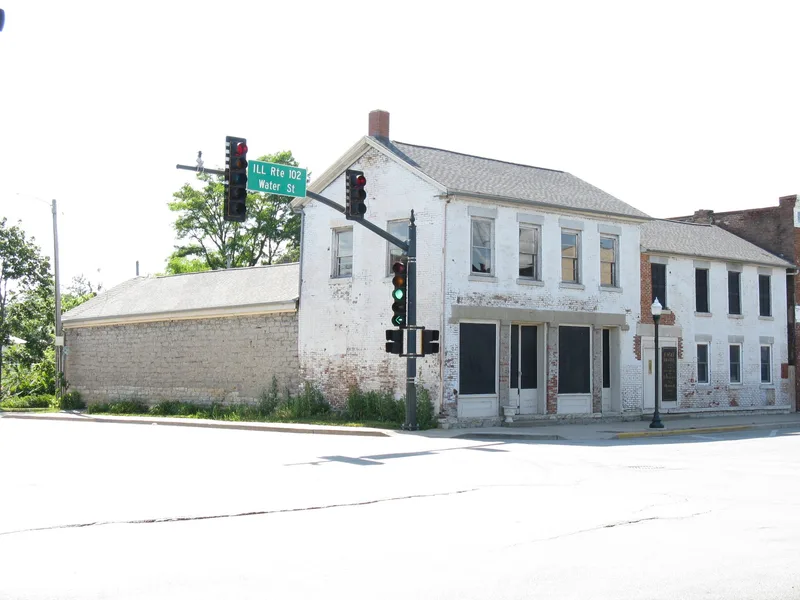
Standing at the corner of Water and Baltimore Streets in Wilmington, Illinois, this L-shaped complex grew in three stages between about 1837 and 1843. The oldest part is a rubble limestone warehouse facing the mill race. Next came a brick inn with Federal-style symmetry and touches of Greek Revival detail, followed by a taller brick section with a commercial storefront and rooms above. Over the years it housed an inn, general stores, boarding rooms and apartments, and the First National Bank of Wilmington opened in the storefront in 1863. It later served as a local historical society museum. Its listing rests on its value as a surviving example of mid-19th century construction and as an early marker of the town's commerce and transportation, which served stagecoach and canalboat travelers and mill customers. A November 1990 fire damaged about one-sixth of the complex, yet the exterior retains much of its original character. The building has been vacant since that fire.
Significance in brief: The nomination argues the building is a locally significant surviving example of mid-19th century architecture (Criterion C). It also reflects the transportation and commercial development of Wilmington (Criterion A), serving as an inn, tavern, warehouse and store for travelers, farmers and mill customers. It is the oldest documented commercial building remaining in the Wilmington area.
Machine-generated summary. This summary was generated by a language model from the official nomination document and has not been reviewed line by line by an editor. It may contain errors. Check the source document before relying on any detail. Source: nomination document (PDF) · National Archives catalog entry. NRHP reference 94000021, listed February 16, 1994. Summary generated October 2026 (model claude-sonnet-5-5, prompt v1.0-2026-10-29, confidence medium).
Key facts
| Address | 100--104 Water St., Wilmington |
|---|---|
| County | Will County |
| Listed | February 16, 1994 |
| Reference number | 94000021 |
| Resource type | Building |
| Period of significance | Architecture 1837-c. 1920s; Transportation 1837-1943 |
| Architect / builder | Unknown |
| Architectural style | Mid-19th Century; Federal and Greek Revival influences |
| Criteria |
|
| Areas of significance | Architecture, Transportation, Commerce |
| Level of significance | Local |
| Status (as stated in the nomination) | Vacated since a severe fire in November 1990; the fire-damaged building was open to the weather while stabilization and restoration plans were being prepared. |
| Acreage | 0.9 |
| Coordinates | 41.30793, -88.14744 (NPS GIS) |
What listing means for this property
For an income-producing building, listing (individually or as a contributing building in a district) is the gateway to the 20% federal rehabilitation tax credit on qualified rehabilitation costs, often stackable with state credits. Work claiming the credit must follow the Secretary of the Interior's Standards and be approved in advance.
Listing does not restrict a private owner acting without federal money or permits; where federal funding or licensing is involved, Section 106 review applies.
Noted as vacant in the nomination. Nomination documents can be decades old; current status may differ. If you are considering buying an empty listed property, read the due-diligence checklist.
General information, not legal or tax advice. Rules change; confirm with your State Historic Preservation Office or a qualified adviser.
Sources and further reading
- National Park Service, National Register of Historic Places database (snapshot May 2026), reference 94000021.
- Nomination form (PDF, National Archives) — catalog entry
- Wikipedia article (used for cross-checking only; text not reproduced here)
- Wikidata Q5325124
- This listing as JSON
Last updated October 2026. Found an error? See the editorial policy for how to report it.