Kirk, Col. Edward N., House
Also known as: Paul W. Dillon Home

Why it's listed
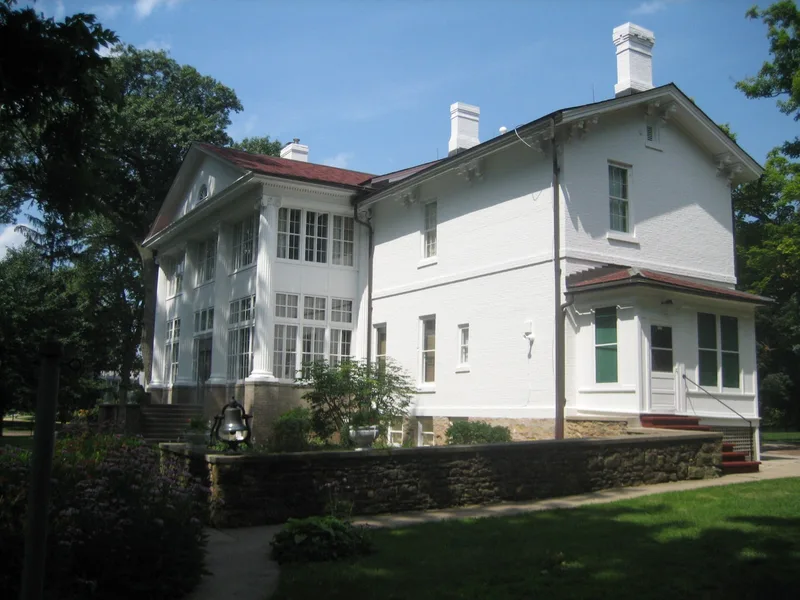
Built in 1857 for Colonel Edward N. Kirk, this brick Italianate house stands on a 5.45-acre site overlooking the Rock River in Sterling, Illinois. Kirk, a Union officer wounded twice in the Civil War, died in Sterling in 1863. The house has two stories, a basement, a viewing tower, a mahogany staircase, marble fireplaces and cherry paneling. A two-story brick barn, built around 1859, remains on the grounds. Newspaper descriptions from the 1870s match the house and barn as they appear today. The only major changes were the enclosure of the veranda in 1920 and a concealed elevator added in 1973. The property is also linked to the Dillon family. Washington M. Dillon founded the Northwestern Barb Wire Company in 1879, and his son Paul W. Dillon was born in the house in 1883 and lived there for decades. Paul Dillon led the company's move into electric furnace steelmaking in the 1930s, and the firm grew into a major steel producer.
Significance in brief: The house was built by Colonel Edward N. Kirk, a Union officer in the Civil War who died in Sterling in 1863. It is also tied to Paul W. Dillon, who lived there most of his life and led Northwestern Steel and Wire Company, a major Sterling employer. Dillon introduced electric furnace steelmaking at the company in 1936 and was recognized across the steel industry.
Machine-generated summary. This summary was generated by a language model from the official nomination document and has not been reviewed line by line by an editor. It may contain errors. Check the source document before relying on any detail. Source: nomination document (PDF) · National Archives catalog entry. NRHP reference 80001417, listed October 9, 1980. Summary generated October 2026 (model claude-sonnet-5-5, prompt v1.0-2026-10-29, confidence medium).
Key facts
| Address | 1005 E. 3rd St., Sterling |
|---|---|
| County | Whiteside County |
| Listed | October 9, 1980 |
| Reference number | 80001417 |
| Resource type | Building |
| Period of significance | 1857-1859 |
| Architect / builder | Unknown (built by Colonel Edward N. Kirk) |
| Architectural style | Italianate (also described as Italian Renaissance) |
| Areas of significance | Industry, Social History |
| Level of significance | State |
| Status (as stated in the nomination) | Occupied; described as in good, altered condition, with a 1920 porch enclosure and a 1973 hidden elevator. The nomination lists the owner as the Sterling Park District, with museum and park uses. |
| Acreage | 5.7 |
| Coordinates | 41.78429, -89.68330 (NPS GIS) |
What listing means for this property
National Register listing is honorary for a privately owned home: it does not by itself restrict what an owner may do with their own money, and it does not require public access. Restrictions come from local landmark or historic-district ordinances, which are separate (how they differ).
Owner-occupied houses are not eligible for the 20% federal rehabilitation tax credit, which applies to income-producing buildings, but many states offer credits for homeowners. Listing also opens the door to preservation easements and to buying a plaque. Start with what listing means for homeowners, renovating a listed house and selling one.
General information, not legal or tax advice. Rules change; confirm with your State Historic Preservation Office or a qualified adviser.
Sources and further reading
- National Park Service, National Register of Historic Places database (snapshot May 2026), reference 80001417.
- Nomination form (PDF, National Archives) — catalog entry
- Wikipedia article (used for cross-checking only; text not reproduced here)
- Wikidata Q7154182
- This listing as JSON
Last updated October 2026. Found an error? See the editorial policy for how to report it.