Allentown Union Hall
Also known as: Allentown Hall

Why it's listed
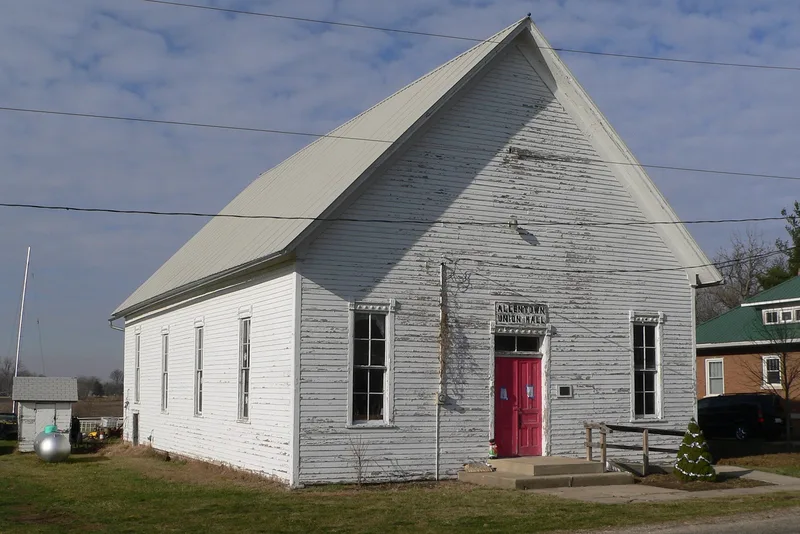
Allentown Union Hall is a one-story, white clapboard community building in the small, unincorporated village of Allentown in Tazewell County, Illinois. Completed and dedicated on October 12, 1892, it measures 36 by 60 feet, with a steep gabled roof, a brick foundation, and a raised stage at the rear. The building has no plumbing, and two small privies stand behind it. The hall grew from the efforts of a local women's group, the Helping Hand Circle, which raised $300 through socials and suppers, with the rest of the cost covered by subscription. For decades it served as a hub for Sunday school, church services, dances, plays, medicine shows, funerals and elections, drawing people from nearby towns when muddy roads limited travel. Its interior, especially the stage and wainscoting, remains largely unaltered. The nomination treats it as a locally significant example of rural social, educational and recreational life between 1892 and 1938, and it is still used for community events.
Significance in brief: The nomination argues the hall is locally significant under Criterion A as a rural community gathering place of the late 19th and early 20th centuries. It hosted education, entertainment, social, religious and civic activities that connected people across a wide area. It was built through the fundraising of a local women's group and community subscription.
Machine-generated summary. This summary was generated by a language model from the official nomination document and has not been reviewed line by line by an editor. It may contain errors. Check the source document before relying on any detail. Source: nomination document (PDF) · National Archives catalog entry. NRHP reference 88001228, listed August 12, 1988. Summary generated October 2026 (model claude-sonnet-5-5, prompt v1.0-2026-10-29, confidence high).
Key facts
| Address | 2 mi. E of IL 121, Allentown |
|---|---|
| County | Tazewell County |
| Listed | August 12, 1988 |
| Reference number | 88001228 |
| Resource type | Building |
| Period of significance | 1892-1938 |
| Architect / builder | White, Unk, John Will (OCR of the Architect/Builder entry is garbled; exact names unclear) |
| Architectural style | Late Victorian |
| Criteria |
|
| Areas of significance | Entertainment/Recreation, Education |
| Level of significance | Local |
| Status (as stated in the nomination) | Still in use for community events, including biennial homecomings begun in 1950; the form describes it as structurally sound with excellent integrity. |
| Acreage | 0.1 |
| Coordinates | 40.55497, -89.40895 (NPS GIS) |
What listing means for this property
National Register listing is honorary for a privately owned home: it does not by itself restrict what an owner may do with their own money, and it does not require public access. Restrictions come from local landmark or historic-district ordinances, which are separate (how they differ).
Owner-occupied houses are not eligible for the 20% federal rehabilitation tax credit, which applies to income-producing buildings, but many states offer credits for homeowners. Listing also opens the door to preservation easements and to buying a plaque. Start with what listing means for homeowners, renovating a listed house and selling one.
General information, not legal or tax advice. Rules change; confirm with your State Historic Preservation Office or a qualified adviser.
Sources and further reading
- National Park Service, National Register of Historic Places database (snapshot May 2026), reference 88001228.
- Nomination form (PDF, National Archives) — catalog entry
- Wikipedia article (used for cross-checking only; text not reproduced here)
- Wikidata Q22033052
- This listing as JSON
Last updated October 2026. Found an error? See the editorial policy for how to report it.