Brunk Farmstead
Also known as: Cotton Hill Farmstead

Why it's listed
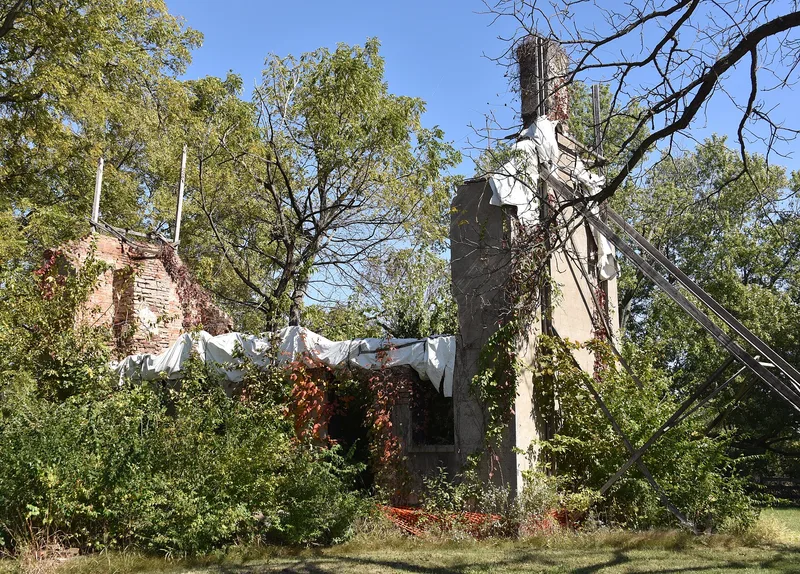
Brunk Farmstead, also called Cotton Hill Farm, sits along KOA Campground Road southeast of Springfield, near Rochester, Illinois. George Brunk built the house and horse barn around 1829. The house began as a one-story stone building with an L-shaped plan and three large stone chimneys. In the 1850s or 1860s it gained a brick second story, a new roof, and bracketed eaves, producing the I-house with a rear service wing seen today. Inside, the early parlor keeps built-in walnut china cupboards, and several mantels blend Federal and Greek Revival details. Original woodwork and nineteenth-century window sash survive upstairs, though the floors have suffered water damage. The farm has worked continuously, and the old barn still shelters horses, while a modern barn is noncontributing. The house is now vacant. The property reflects early Sangamon County settlement, the nearby Horse Creek community, and the way central Illinois farms changed over time.
Significance in brief: The house retains early stone construction and interior details from the late 1820s, including Federal and Greek Revival mantels and built-in walnut china cupboards. Its later second-story remodeling and the continuous farm use reflect changing farming and building practices in central Illinois. The farmstead also illustrates the early settlement of Cotton Hill Township and the Horse Creek area.
Machine-generated summary. This summary was generated by a language model from the official nomination document and has not been reviewed line by line by an editor. It may contain errors. Check the source document before relying on any detail. Source: nomination document (PDF) · National Archives catalog entry. NRHP reference 99001569, listed December 17, 1999. Summary generated October 2026 (model claude-sonnet-5-5, prompt v1.0-2026-10-29, confidence medium).
Key facts
| Address | KOA Campground Rd., i mi. S. of E. Lake Dr., Rochester |
|---|---|
| County | Sangamon County |
| Listed | December 17, 1999 |
| Reference number | 99001569 |
| Resource type | Building |
| Architect / builder | George Brunk |
| Architectural style | Greek Revival (Mid-19th Century) |
| Areas of significance | Architecture, Agriculture |
| Level of significance | Local |
| Status (as stated in the nomination) | The Brunk House is described as vacant; the historic horse barn is still used to house horses, and the surrounding land remains agricultural. The north wall of the rear wing was demolished for deterioration and covered with plywood. |
| Acreage | 5 |
| Coordinates | 39.69762, -89.58667 (NPS GIS) |
What listing means for this property
National Register listing is honorary for a privately owned home: it does not by itself restrict what an owner may do with their own money, and it does not require public access. Restrictions come from local landmark or historic-district ordinances, which are separate (how they differ).
Owner-occupied houses are not eligible for the 20% federal rehabilitation tax credit, which applies to income-producing buildings, but many states offer credits for homeowners. Listing also opens the door to preservation easements and to buying a plaque. Start with what listing means for homeowners, renovating a listed house and selling one.
Noted as vacant in the nomination. Nomination documents can be decades old; current status may differ. If you are considering buying an empty listed property, read the due-diligence checklist.
General information, not legal or tax advice. Rules change; confirm with your State Historic Preservation Office or a qualified adviser.
Sources and further reading
- National Park Service, National Register of Historic Places database (snapshot May 2026), reference 99001569.
- Nomination form (PDF, National Archives) — catalog entry
- Wikipedia article (used for cross-checking only; text not reproduced here)
- Wikidata Q19460703
- This listing as JSON
Last updated October 2026. Found an error? See the editorial policy for how to report it.