Principia College Historic District
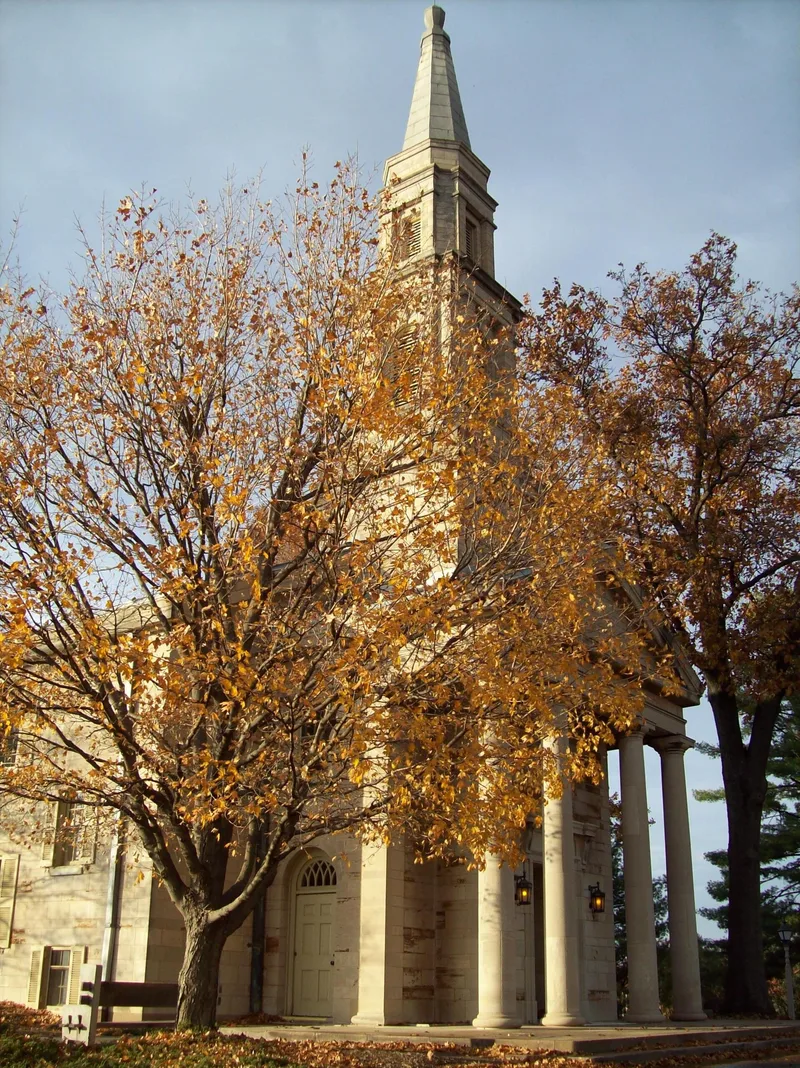

Why it's listed
Principia College occupies limestone bluffs above the Mississippi River at Elsah, Illinois, and was planned as an English village that follows the hills. The college serves young Christian Scientists. Its plan began in the 1920s for a Missouri lakeside site, but the site was changed in 1930 to the Illinois bluffs. San Francisco architect Bernard Maybeck designed the campus buildings from 1931, working closely with college director Frederic Morgan. Henry Gutterson later completed many of the designs. Buildings combine brick, stone, half-timbering, concrete and tile roofs, with a Colonial-style chapel of Indiana limestone. The district includes 24 contributing buildings from 1931 to 1946, and later college buildings from the 1950s to the 1980s are counted as noncontributing. It is considered significant as the last major phase of Maybeck's career and for its concentration of his work, eleven of whose buildings survive here. The landscape plan was by Butler Sturtevant.
Significance in brief: The district is argued to represent the final phase of Bernard Maybeck's career and his significant work in campus planning for educational institutions. The commission kept his office working through the Great Depression. Maybeck designed 13 buildings at Elsah, 11 of which survive, and the concentration rivals his surviving houses in the Berkeley Hills.
Machine-generated summary. This summary was generated by a language model from the official nomination document and has not been reviewed line by line by an editor. It may contain errors. Check the source document before relying on any detail. Source: nomination document (PDF) · National Archives catalog entry. NRHP reference 93001605, listed April 19, 1993. Summary generated October 2026 (model claude-sonnet-5-5, prompt v1.0-2026-10-29, confidence high).
Key facts
| Address | River Rd., Elsah |
|---|---|
| County | Jersey County |
| Listed | April 19, 1993 |
| Reference number | 93001605 |
| Resource type | District |
| Period of significance | 1931-1946 |
| Architect / builder | Bernard Maybeck (1862-1957); Henry Gutterson (1884-1954) |
| Architectural style | Late 19th and Early 20th Century American Revivals: Tudor Revival; Colonial Revival |
| Criteria |
|
| Areas of significance | Architecture |
| Level of significance | National |
| National Historic Landmark | Yes, designated April 19, 1993 |
| Status (as stated in the nomination) | Still in use as a college (education use listed for both historic and current function); 24 contributing and 23 noncontributing buildings. |
| Acreage | 290 |
| Coordinates | 38.95151, -90.35128 (NPS GIS) |
What listing means for this property
This is a historic district. Buildings within its boundary are either contributing (they add to the district's significance) or non-contributing. Owners of contributing income-producing buildings can claim the 20% federal rehabilitation tax credit; homeowners should look at state credits. National Register districts impose no design review by themselves; a local historic district ordinance, if one exists, does (the difference explained).
General information, not legal or tax advice. Rules change; confirm with your State Historic Preservation Office or a qualified adviser.
Sources and further reading
- National Park Service, National Register of Historic Places database (snapshot May 2026), reference 93001605.
- Nomination form (PDF, National Archives) — catalog entry
- Wikipedia article (used for cross-checking only; text not reproduced here)
- Wikidata Q7245136
- This listing as JSON
Last updated October 2026. Found an error? See the editorial policy for how to report it.