Elsah Historic District
Also known as: Jersey Landing
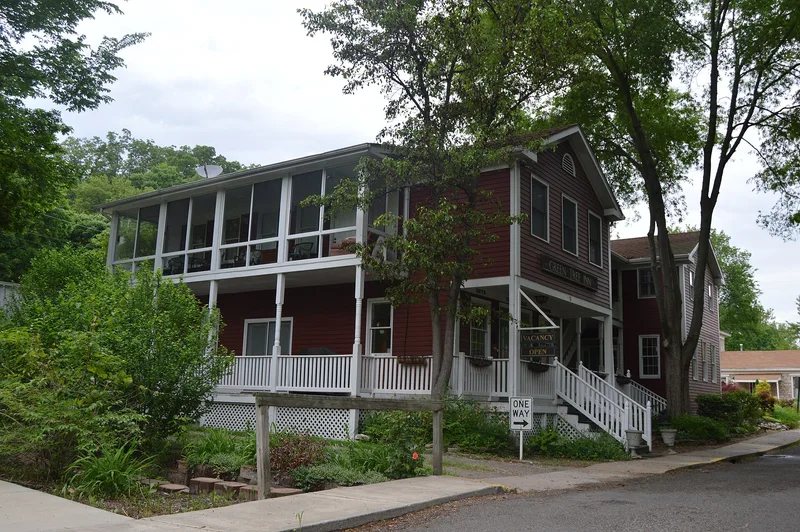

Why it's listed
Elsah is a small Mississippi River village in Jersey County, Illinois, surveyed and named by James Semple in 1853 and essentially full-grown by about 1861. The historic district holds roughly 48 buildings with 19th-century portions, including 19 stone buildings, five early brick houses and an early frame hotel. Most follow a rural Greek Revival style, with a few mansard-roofed, Italianate and American Gothic touches. Three areas keep nearly unchanged 19th-century views: the former business district along LaSalle Street, three blocks of Mill Street, and a row of brick and stone houses between Elm and Alpa Streets. The old commercial street still has its four taverns and hotel. Remains of a railroad tunnel and cut recall Jay Gould's 1880s plans. Poverty, isolation and the long holding of surrounding land by two families, then Principia College, kept change small. A filling station by architect Bernard Maybeck is among the few notable modern additions.
Significance in brief: The nomination calls Elsah one of the best-preserved river towns left on the northern Mississippi River, with a strong 1850s atmosphere. Its buildings, mostly built before 1861, show a remarkable architectural continuity, chiefly rural Greek Revival. The surviving commercial street, taverns and hotel show the economy of a small river town, and the setting has stayed largely unchanged.
Machine-generated summary. This summary was generated by a language model from the official nomination document and has not been reviewed line by line by an editor. It may contain errors. Check the source document before relying on any detail. Source: nomination document (PDF) · National Archives catalog entry. NRHP reference 73000706, listed July 27, 1973. Summary generated October 2026 (model claude-sonnet-5-5, prompt v1.0-2026-10-29, confidence medium).
Key facts
| Address | N of McAdams Hwy., Elsah |
|---|---|
| County | Jersey County |
| Listed | July 27, 1973 |
| Reference number | 73000706 |
| Resource type | District |
| Period of significance | 1847-1900 |
| Architectural style | Rural Greek Revival, with Second Empire, Italianate and American Gothic examples |
| Areas of significance | Community Planning and Development, Commerce, Transportation, Architecture |
| Level of significance | National, State |
| Status (as stated in the nomination) | Described as occupied, in fair condition and somewhat altered, with uses including private residence, commercial, educational, religious, museum and park; preservation work was in progress. |
| Acreage | 352.5 |
| Coordinates | 38.95924, -90.36013 (NPS GIS) |
What listing means for this property
This is a historic district. Buildings within its boundary are either contributing (they add to the district's significance) or non-contributing. Owners of contributing income-producing buildings can claim the 20% federal rehabilitation tax credit; homeowners should look at state credits. National Register districts impose no design review by themselves; a local historic district ordinance, if one exists, does (the difference explained).
General information, not legal or tax advice. Rules change; confirm with your State Historic Preservation Office or a qualified adviser.
Sources and further reading
- National Park Service, National Register of Historic Places database (snapshot May 2026), reference 73000706.
- Nomination form (PDF, National Archives) — catalog entry
- Wikipedia article (used for cross-checking only; text not reproduced here)
- Wikidata Q18149871
- This listing as JSON
Last updated October 2026. Found an error? See the editorial policy for how to report it.