South Henderson Church and Cemetery

Why it's listed
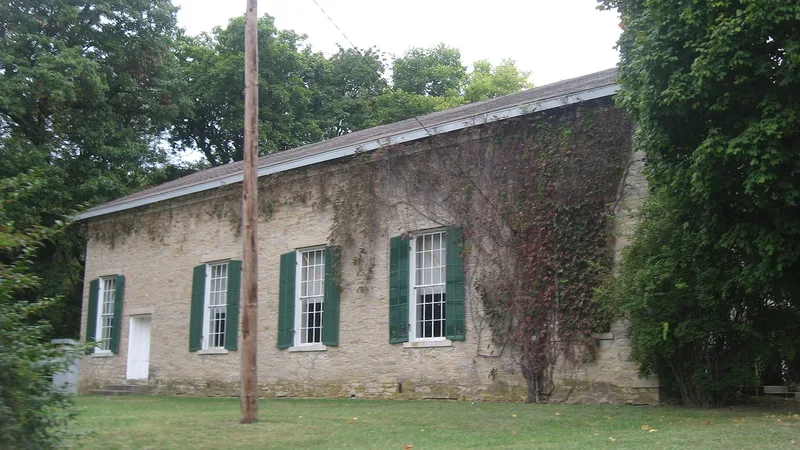
South Henderson Church and Cemetery is a rural complex in Henderson County, Illinois, made up of a limestone church and a burial ground across an unimproved road. The rectangular building, 45 by 70 feet, was begun in 1854 and first used for services in July 1855, free of debt. Members of the congregation hauled the local limestone from a nearby creek. Its two front doorways recall the custom of seating men and women separately. The congregation formed in 1835 under settlers from Indiana led by David Finley, meeting first in a barn and then in a wood church built in 1837. In 1852 the Reverend Robert Ross and a fellow minister proposed an academy at Monmouth, which became Monmouth College. The cemetery holds Revolutionary War soldiers and veterans of later nineteenth-century wars. The congregation disbanded in 1954, and a cemetery association cares for the grounds.
Significance in brief: The congregation, organized in 1835, reflects the role of religion in frontier settlement in Illinois. Action to found Monmouth College was initiated here in 1852. The 1854 building is also cited as a fine example of vernacular architecture and craftsmanship.
Machine-generated summary. This summary was generated by a language model from the official nomination document and has not been reviewed line by line by an editor. It may contain errors. Check the source document before relying on any detail. Source: nomination document (PDF) · National Archives catalog entry. NRHP reference 76000709, listed October 14, 1976. Summary generated October 2026 (model claude-sonnet-5-5, prompt v1.0-2026-10-29, confidence medium).
Key facts
| Address | E of Gladstone, Gladstone |
|---|---|
| County | Henderson County |
| Listed | October 14, 1976 |
| Reference number | 76000709 |
| Resource type | Building |
| Period of significance | 1835-1954 |
| Architectural style | Vernacular religious architecture, with Greek Revival elements noted on the review sheet |
| Areas of significance | Education, Architecture, Religion |
| Level of significance | Local |
| Status (as stated in the nomination) | Described as in excellent condition and well cared for, with expenses covered by a bequest; the congregation disbanded in 1954. |
| Acreage | 5 |
| Coordinates | 40.87253, -90.91293 (NPS GIS) |
What listing means for this property
Religious properties are listed for their architectural or historical significance, not their religious use. Listing is honorary and does not restrict the congregation's use of the building. The federal rehabilitation credit is generally unavailable unless part of the building is income-producing; some state programmes and preservation grants do cover religious buildings. Federal funding or permits trigger Section 106 review.
General information, not legal or tax advice. Rules change; confirm with your State Historic Preservation Office or a qualified adviser.
Sources and further reading
- National Park Service, National Register of Historic Places database (snapshot May 2026), reference 76000709.
- Nomination form (PDF, National Archives) — catalog entry
- Wikipedia article (used for cross-checking only; text not reproduced here)
- Wikidata Q16900375
- This listing as JSON
Last updated October 2026. Found an error? See the editorial policy for how to report it.