Wayne Village Historic District

Why it's listed
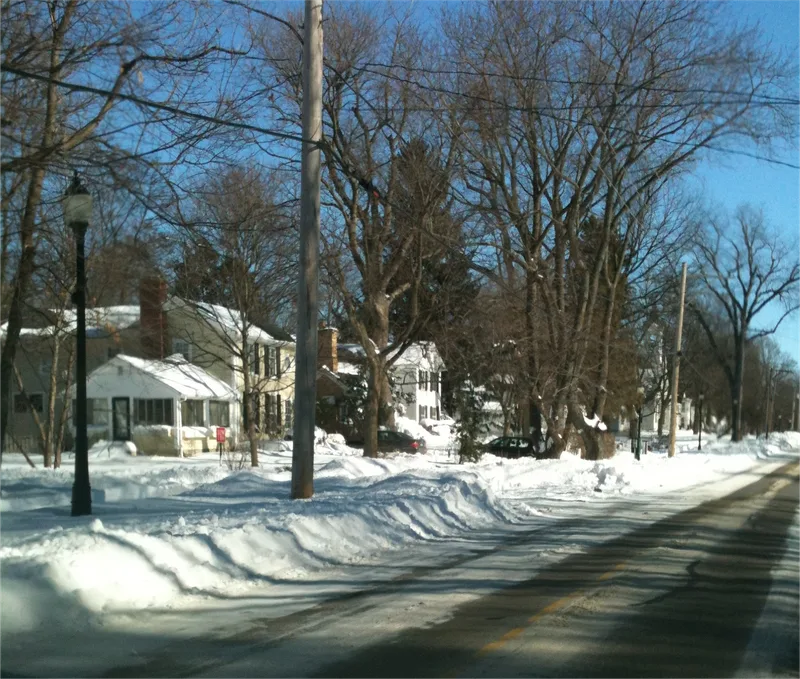
Wayne Village Historic District preserves the 19th-century core of a small railroad settlement about 35 miles west of Chicago in DuPage County, Illinois. Of its 53 structures, at least 39 were built by 1916 and all but four before 1929. Nearly all are frame, detached houses set well back from Army Trail Road and Glos Street, with a church, a small store, and a post office as exceptions. The settlement began when Solomon Dunham built a house, store and inn after the Galena and Chicago Union Railroad arrived in 1850. Growth accelerated from the 1880s because of the nearby Oaklawn Farm horse-breeding enterprise, and it slowed after that operation ended in 1929. No single building is outstanding, and ten have been heavily altered, but the village as a whole still reads as a rural community from before World War I. That intact ensemble, rare in the Chicago area, is the reason for its listing.
Significance in brief: The nomination argues that Wayne is a typical rural settlement that grew up along an early railroad, but unusually it neither vanished nor became a suburb. It remains largely as it was before World War I. Its growth was tied to the Oaklawn Farm horse-breeding operation, and the district is valued as an intact ensemble rather than for individual landmarks.
Machine-generated summary. This summary was generated by a language model from the official nomination document and has not been reviewed line by line by an editor. It may contain errors. Check the source document before relying on any detail. Source: nomination document (PDF) · National Archives catalog entry. NRHP reference 78003106, listed December 29, 1978. Summary generated October 2026 (model claude-sonnet-5-5, prompt v1.0-2026-10-29, confidence medium).
Key facts
| Address | Irregular pattern along Army Trail Rd., Wayne |
|---|---|
| County | DuPage County |
| Listed | December 29, 1978 |
| Reference number | 78003106 |
| Resource type | District |
| Period of significance | 1800-1899 |
| Architectural style | Simplified vernacular rural dwellings with Greek Revival, Italianate and Queen Anne influences |
| Areas of significance | Social History |
| Level of significance | Local |
| Status (as stated in the nomination) | Condition is marked excellent; the district is almost entirely residential, with a church and a small commercial-governmental group by the railroad. Ten structures have been extensively altered. |
| Acreage | 34 |
| Coordinates | 41.95217, -88.24797 (NPS GIS) |
What listing means for this property
This is a historic district. Buildings within its boundary are either contributing (they add to the district's significance) or non-contributing. Owners of contributing income-producing buildings can claim the 20% federal rehabilitation tax credit; homeowners should look at state credits. National Register districts impose no design review by themselves; a local historic district ordinance, if one exists, does (the difference explained).
General information, not legal or tax advice. Rules change; confirm with your State Historic Preservation Office or a qualified adviser.
Sources and further reading
- National Park Service, National Register of Historic Places database (snapshot May 2026), reference 78003106.
- Nomination form (PDF, National Archives) — catalog entry
- Wikipedia article (used for cross-checking only; text not reproduced here)
- Wikidata Q7976747
- This listing as JSON
Last updated October 2026. Found an error? See the editorial policy for how to report it.