East Village Historic District

Why it's listed
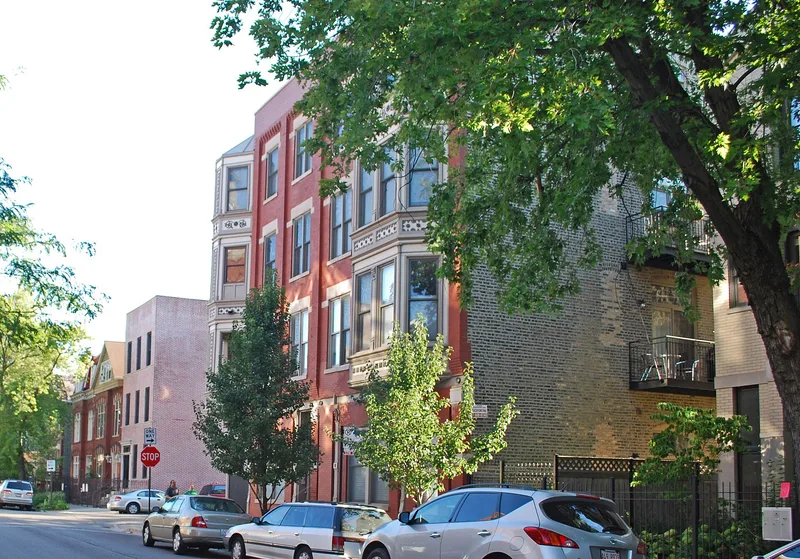
East Village is a dense residential neighborhood in Chicago's West Town area, about three miles northwest of the Loop. Of its 630 resources, 470 contribute to the district's character, including 563 primary buildings, 66 coach houses and a park. Most buildings date from 1870 to 1920 and are solid brick or stone, a choice likely influenced by fireproofing concerns after the Great Chicago Fire of 1871. Housing types include gable-front cottages, two- and three-flats, six-flats, walk-up apartments, and a smaller number of corner buildings combining shops and homes. Ornament draws on Italianate, Queen Anne, Romanesque Revival and Classical Revival styles. The district was listed for its connection to Ethnic Heritage, as an area of first settlement for German immigrants who arrived during the city's rapid growth in the late nineteenth and early twentieth centuries. Narrow alleys, uniform lot sizes, tree-lined parkways and the Commercial Club Playground give the area a consistent, pedestrian-scaled character, although recent teardown construction has intruded in places.
Significance in brief: The district is significant under Criterion A for Ethnic Heritage (European), as an area of first settlement by German immigrants between 1870 and 1920. Its dense stock of solid masonry housing reflects the building boom that followed industrial and rail improvements and the rebuilding after the Great Chicago Fire of 1871.
Machine-generated summary. This summary was generated by a language model from the official nomination document and has not been reviewed line by line by an editor. It may contain errors. Check the source document before relying on any detail. Source: nomination document (PDF) · National Archives catalog entry. NRHP reference 09000459, listed December 8, 2009. Summary generated October 2026 (model claude-sonnet-5-5, prompt v1.0-2026-10-29, confidence high).
Key facts
| Address | Bounded by Division St. and Chicago, Hermitage and Damen Aves., Chicago |
|---|---|
| County | Cook County |
| Listed | December 8, 2009 |
| Reference number | 09000459 |
| Resource type | District |
| Period of significance | 1870-1920 |
| Architectural style | Late Victorian; Late 19th and 20th Century Revivals; Late 19th and Early 20th Century American Movements (Italianate, Queen Anne, Romanesque Revival and Classical Revival ornament) |
| Criteria |
|
| Areas of significance | European |
| Level of significance | Local |
| Status (as stated in the nomination) | Historic buildings are overall in good condition and retain their historic character, though some have lost original windows or siding and about 122 non-contributing buildings were built between 1990 and 2009. Most buildings remain in residential use. |
| Acreage | 67 |
| Within district | Chicago Park Boulevard System Historic District |
| Coordinates | 41.89888, -87.67628 (NPS GIS) |
What listing means for this property
This is a historic district. Buildings within its boundary are either contributing (they add to the district's significance) or non-contributing. Owners of contributing income-producing buildings can claim the 20% federal rehabilitation tax credit; homeowners should look at state credits. National Register districts impose no design review by themselves; a local historic district ordinance, if one exists, does (the difference explained).
General information, not legal or tax advice. Rules change; confirm with your State Historic Preservation Office or a qualified adviser.
Sources and further reading
- National Park Service, National Register of Historic Places database (snapshot May 2026), reference 09000459.
- Nomination form (PDF, National Archives) — catalog entry
- Wikipedia article (used for cross-checking only; text not reproduced here)
- Wikidata Q65054456
- This listing as JSON
Last updated October 2026. Found an error? See the editorial policy for how to report it.