Abbott, Robert S., House

Why it's listed
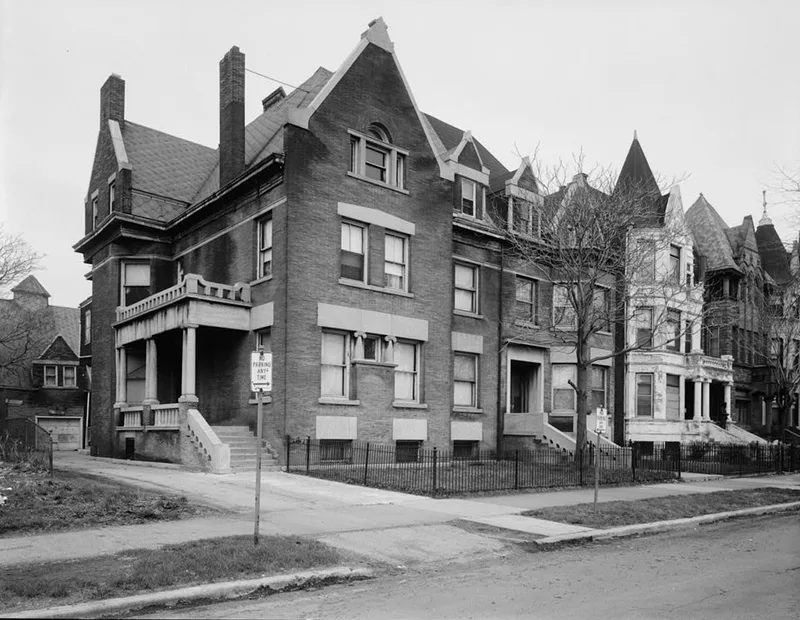
Once a showpiece of sumptuous living on Chicago's South Side, this brick townhouse at 4742 Martin Luther King Drive was built as one half of a duplex. Its Queen Anne character shows in the Dutch gable roof, raised stone parapets, dormers and grouped chimneys, mixed with limestone Ionic and Doric details. Inside, carved oak pilasters, exposed beams and a grand staircase remain. A former coach house stands behind it. The house matters chiefly for its owner, Robert Sengstacke Abbott, who founded the Chicago Defender in 1905 and built it into a newspaper with a weekly circulation above a quarter million by 1929. Its coverage urged Southern blacks to move north and challenged racism in Chicago and elsewhere. Abbott bought the house in 1926 for $24,000 and sold it to his publishing company in 1934. It stayed in the company's estate until 1944. Abbott died in 1940. The building has since been converted to a rooming house.
Significance in brief: It was the home of Robert S. Abbott (1870-1940), founder of the Chicago Defender, the most successful black newspaper of its era. Through the Defender he encouraged the northward migration of Southern blacks and campaigned against racism. He bought the house in 1926 and lived there until 1940.
Machine-generated summary. This summary was generated by a language model from the official nomination document and has not been reviewed line by line by an editor. It may contain errors. Check the source document before relying on any detail. Source: nomination document (PDF) · National Archives catalog entry. NRHP reference 76000686, listed December 8, 1976. Summary generated October 2026 (model claude-sonnet-5-5, prompt v1.0-2026-10-29, confidence high).
Key facts
| Address | 4742 Martin Luther King, Jr. Dr., Chicago |
|---|---|
| County | Cook County |
| Listed | December 8, 1976 |
| Reference number | 76000686 |
| Resource type | Building |
| Period of significance | 1926-1940 |
| Architectural style | Queen Anne with Neo-Classical elements |
| Areas of significance | Black, Literature |
| Level of significance | National |
| National Historic Landmark | Yes, designated December 8, 1976 |
| Status (as stated in the nomination) | Converted to a rooming house and described as a shell of its former elegance; brickwork needs tuckpointing and cleaning, and a poorly executed rear porch was added. The classification lists it as occupied, with an apartment building as present use. |
| Acreage | 0.9 |
| Within district | Chicago Park Boulevard System Historic District |
| Coordinates | 41.81002, -87.61619 (NPS GIS) |
What listing means for this property
National Register listing is honorary for a privately owned home: it does not by itself restrict what an owner may do with their own money, and it does not require public access. Restrictions come from local landmark or historic-district ordinances, which are separate (how they differ).
Owner-occupied houses are not eligible for the 20% federal rehabilitation tax credit, which applies to income-producing buildings, but many states offer credits for homeowners. Listing also opens the door to preservation easements and to buying a plaque. Start with what listing means for homeowners, renovating a listed house and selling one.
General information, not legal or tax advice. Rules change; confirm with your State Historic Preservation Office or a qualified adviser.
Sources and further reading
- National Park Service, National Register of Historic Places database (snapshot May 2026), reference 76000686.
- Nomination form (PDF, National Archives) — catalog entry
- Wikipedia article (used for cross-checking only; text not reproduced here)
- Wikidata Q7349443
- This listing as JSON
Last updated October 2026. Found an error? See the editorial policy for how to report it.