Cattle Bank
Also known as: Heimlicher's Drug Store

Why it's listed
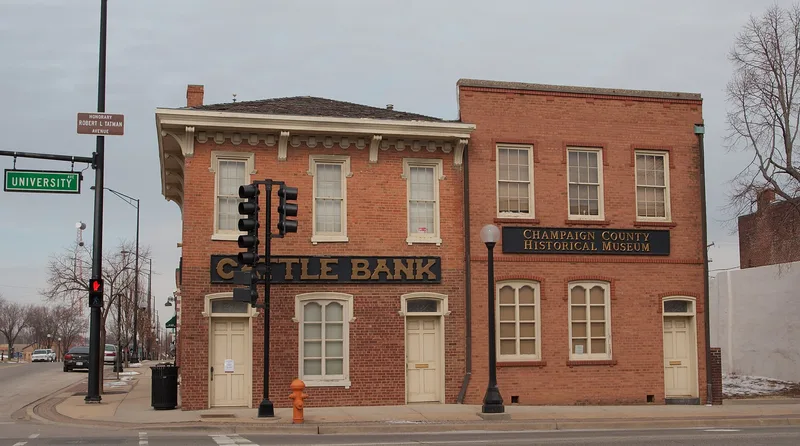
Built around the late 1850s at what is now 102 East University Avenue in Champaign, this two-story brick building began as the Cattle Bank, a branch of the Grand Prairie Bank of Urbana. It was opened to serve cattlemen who raised herds on the surrounding prairies and had driven them overland to Indianapolis or Chicago. The railroad promised quicker shipment to Chicago and the banking and loan business that went with it. The bank closed around 1861 after a failed investment in Missouri bonds. The building later housed mineral water manufacturing, a grocery and, from 1936 to 1971, a drug store. A fire in 1971 damaged the interior, and the building has since stood boarded up. The second floor, window ornamentation, roof and dentil cornice remain largely original, and original tin ceilings survive inside. It is recognized as the oldest remaining business building in Champaign.
Significance in brief: The nomination argues the building reflects the cattle-marketing economy of the prairie before the railroad, when the Cattle Bank served local cattlemen as a branch of Urbana's first bank. It is also described as the oldest remaining business building in Champaign.
Machine-generated summary. This summary was generated by a language model from the official nomination document and has not been reviewed line by line by an editor. It may contain errors. Check the source document before relying on any detail. Source: nomination document (PDF) · National Archives catalog entry. NRHP reference 75000642, listed August 19, 1975. Summary generated October 2026 (model claude-sonnet-5-5, prompt v1.0-2026-10-29, confidence medium).
Key facts
| Address | 102 E. University Ave., Champaign |
|---|---|
| County | Champaign County |
| Listed | August 19, 1975 |
| Reference number | 75000642 |
| Resource type | Building |
| Period of significance | Late 1850s (19th century) |
| Architectural style | Italianate |
| Areas of significance | Commerce |
| Level of significance | State |
| Status (as stated in the nomination) | Fire in 1971 damaged the interior and the building was not repaired or reopened; the first floor windows and doors were boarded up. The form describes the interior as deteriorating and the building as vacant. |
| Acreage | 0.1 |
| Coordinates | 40.11660, -88.23852 (NPS GIS) |
What listing means for this property
For an income-producing building, listing (individually or as a contributing building in a district) is the gateway to the 20% federal rehabilitation tax credit on qualified rehabilitation costs, often stackable with state credits. Work claiming the credit must follow the Secretary of the Interior's Standards and be approved in advance.
Listing does not restrict a private owner acting without federal money or permits; where federal funding or licensing is involved, Section 106 review applies.
Noted as vacant in the nomination. Nomination documents can be decades old; current status may differ. If you are considering buying an empty listed property, read the due-diligence checklist.
General information, not legal or tax advice. Rules change; confirm with your State Historic Preservation Office or a qualified adviser.
Sources and further reading
- National Park Service, National Register of Historic Places database (snapshot May 2026), reference 75000642.
- Nomination form (PDF, National Archives) — catalog entry
- Wikipedia article (used for cross-checking only; text not reproduced here)
- Wikidata Q17515086
- This listing as JSON
Last updated October 2026. Found an error? See the editorial policy for how to report it.