Marsh-Warthen House

Why it's listed
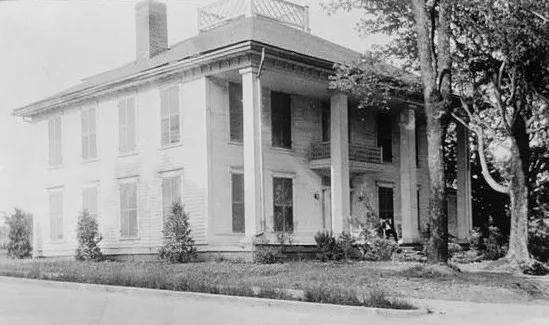
Built around 1836-1837 just north of downtown LaFayette, this two-story wood-framed house follows a Georgian plan, with a central hall and two rooms on each side. Its Greek Revival features include a low hipped roof, square Doric columns, a symmetrical front and a door with sidelights and transom. Colonial Revival dormers and a roof balustrade were added in the early twentieth century, along with a two-story rear kitchen addition. Spencer Marsh, who moved to the area from Newton County around 1835, built it after Cherokee removal opened Walker County to white settlement. He was a merchant, helped organize the Trion Factory, served as a judge and state senator, and donated land for Chattooga Academy. Enslaved people lived on the property, and the form suggests they likely helped build the house. Marsh descendants lived there until 1989. It is recognized for architecture, early settlement and local social history, and is now vacant.
Significance in brief: The house is argued to be an excellent, intact example of a Georgian-type house with early Greek Revival detailing and later Colonial Revival additions, on what was then the Georgia frontier. It is also significant for early white settlement after Cherokee removal, and for the community leadership of Spencer Marsh, a merchant, state senator and school supporter.
Machine-generated summary. This summary was generated by a language model from the official nomination document and has not been reviewed line by line by an editor. It may contain errors. Check the source document before relying on any detail. Source: nomination document (PDF) · National Archives catalog entry. NRHP reference 04001467, listed January 12, 2005. Summary generated October 2026 (model claude-sonnet-5-5, prompt v1.0-2026-10-29, confidence high).
Key facts
| Address | N. Main St., Lafayette |
|---|---|
| County | Walker County |
| Listed | January 12, 2005 |
| Reference number | 04001467 |
| Resource type | Building |
| Period of significance | c.1836-c.1935 |
| Architect / builder | Spencer Marsh |
| Architectural style | Mid-19th Century/Greek Revival; Late 19th and 20th Century Revivals/Colonial Revival; Other/Georgian House |
| Criteria |
|
| Areas of significance | Architecture, Exploration/Settlement, Social History |
| Level of significance | Local |
| Status (as stated in the nomination) | Current function is listed as vacant/not in use. The house was home to Marsh family descendants from c. 1836 until 1989. |
| Acreage | 1.6 |
| Coordinates | 34.70927, -85.28107 (NPS GIS) |
What listing means for this property
National Register listing is honorary for a privately owned home: it does not by itself restrict what an owner may do with their own money, and it does not require public access. Restrictions come from local landmark or historic-district ordinances, which are separate (how they differ).
Owner-occupied houses are not eligible for the 20% federal rehabilitation tax credit, which applies to income-producing buildings, but many states offer credits for homeowners. Listing also opens the door to preservation easements and to buying a plaque. Start with what listing means for homeowners, renovating a listed house and selling one.
Noted as vacant in the nomination. Nomination documents can be decades old; current status may differ. If you are considering buying an empty listed property, read the due-diligence checklist.
General information, not legal or tax advice. Rules change; confirm with your State Historic Preservation Office or a qualified adviser.
Sources and further reading
- National Park Service, National Register of Historic Places database (snapshot May 2026), reference 04001467.
- Nomination form (PDF, National Archives) — catalog entry
- Wikipedia article (used for cross-checking only; text not reproduced here)
- Wikidata Q29093033
- This listing as JSON
Last updated October 2026. Found an error? See the editorial policy for how to report it.