Parrott Historic District

Why it's listed
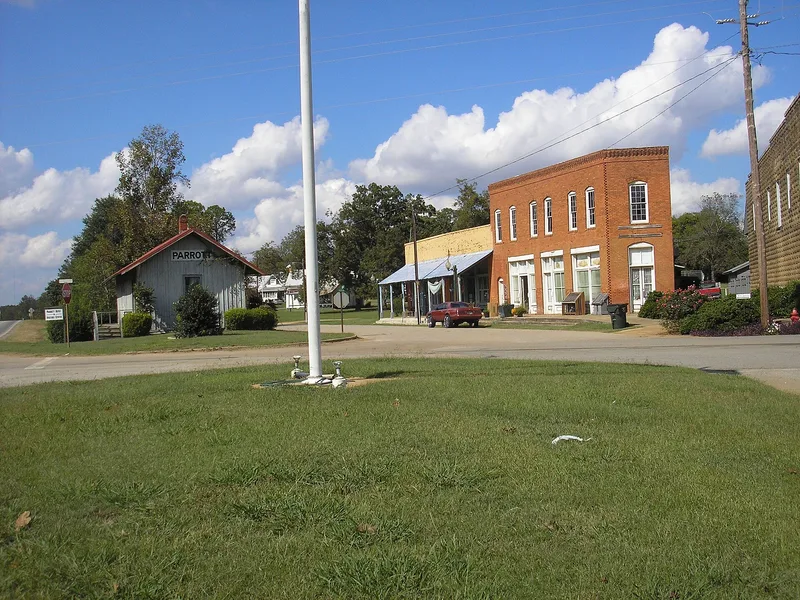
Parrott is a small agricultural town in northern Terrell County, Georgia, laid out in a gridiron pattern along a railroad line and surrounded by farmland and pecan groves. The historic district covers homes with outbuildings, brick commercial buildings along Main and Railroad Streets, three churches, three cemeteries, and a group of cotton and peanut processing and storage buildings south of downtown. Resources date mainly from the 1890s to the 1920s, with some built into the 1950s. Notable buildings include the 1912 Classical Revival Pierce Exchange Bank, a circa 1907 stone-faced concrete block building, the railroad depot, and churches built in 1892, 1920 and 1943. The town was recognized for its architecture, which shows local adaptations of popular styles, and for its role as a trade, warehousing and shipping center for the surrounding area. John L. Parrott subdivided his land as the Columbus Southern Railroad arrived in 1890, shaping the plan that survives.
Significance in brief: The district is a good example of a southwest Georgia town that grew because of the cotton and peanut industries and the railroad. It is significant for architecture, commerce, agriculture, community planning and transportation. It retains an intact railroad-influenced plan and many industrial buildings.
Machine-generated summary. This summary was generated by a language model from the official nomination document and has not been reviewed line by line by an editor. It may contain errors. Check the source document before relying on any detail. Source: nomination document (PDF) · National Archives catalog entry. NRHP reference 04000528, listed May 26, 2004. Summary generated October 2026 (model claude-sonnet-5-5, prompt v1.0-2026-10-29, confidence high).
Key facts
| Address | Roughly centered on the jct. of Main St. and GA Hwy 55/GA Hwy 520, Parrott |
|---|---|
| County | Terrell County |
| Listed | May 26, 2004 |
| Reference number | 04000528 |
| Resource type | District |
| Period of significance | 1889-1953 |
| Architect / builder | Unknown |
| Architectural style | Colonial Revival, Classical Revival, Mediterranean Revival, Commercial Style, Craftsman, Folk Victorian, English Vernacular Revival, and several vernacular house types |
| Criteria |
|
| Areas of significance | Agriculture, Architecture, Commerce, Community Planning and Development, Transportation |
| Level of significance | Local |
| Status (as stated in the nomination) | Most resources remain in use as homes, shops, churches, and city hall; the depot serves as a visitors' center and local museum, and the municipal cemetery is still in use. |
| Acreage | 283 |
| Coordinates | 31.89268, -84.50983 (NPS GIS) |
What listing means for this property
This is a historic district. Buildings within its boundary are either contributing (they add to the district's significance) or non-contributing. Owners of contributing income-producing buildings can claim the 20% federal rehabilitation tax credit; homeowners should look at state credits. National Register districts impose no design review by themselves; a local historic district ordinance, if one exists, does (the difference explained).
General information, not legal or tax advice. Rules change; confirm with your State Historic Preservation Office or a qualified adviser.
Sources and further reading
- National Park Service, National Register of Historic Places database (snapshot May 2026), reference 04000528.
- Nomination form (PDF, National Archives) — catalog entry
- Wikidata Q141810074
- This listing as JSON
Last updated October 2026. Found an error? See the editorial policy for how to report it.