Lockhart-Cosby Plantation
Also known as: Lockhart--Cosby--Jarrell Plantation

Why it's listed
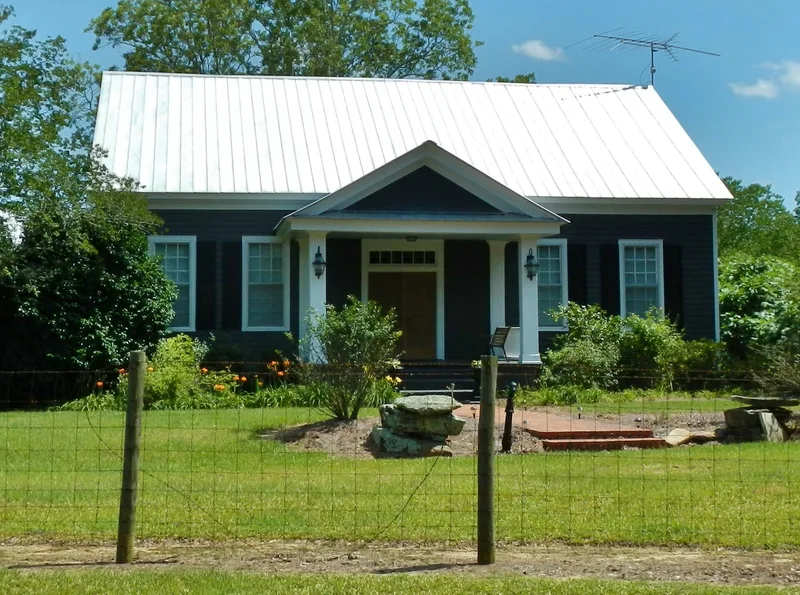
Seven miles east of Talbotton, Georgia, on GA 208, this 33-acre property preserves a Greek Revival farmhouse of about 1840 along with the remnants of a working plantation. David Lockhart began building the one-and-one-half story heart pine house after buying land in 1838-1839. It has a pedimented portico, double entrance doors with a transom, stone and handmade brick chimneys, classical mantels, wainscoting and its original floor plan. Outbuildings include a seed house, tool house, a ca. 1880 barn, a slave house chimney and the family cemetery. In antebellum years the plantation grew cotton and corn with enslaved labor, and it later became a dairy farm. Family tradition holds that the Lockharts lodged travelers on the main Macon-to-Columbus road, using an upstairs reached by an exterior stair. Lockhart also served as local postmaster from 1835 to 1842. The property is valued for its architecture, agriculture and transportation history.
Significance in brief: The house is a good example of a small rural Greek Revival farmhouse with a pedimented portico and central-hall plan, retaining much original material. It is also tied to the area's cotton and corn plantation history, which continued into a dairy farm. Tradition holds that the house served as a stagecoach stop on the Macon-to-Columbus road.
Machine-generated summary. This summary was generated by a language model from the official nomination document and has not been reviewed line by line by an editor. It may contain errors. Check the source document before relying on any detail. Source: nomination document (PDF) · National Archives catalog entry. NRHP reference 94001215, listed October 14, 1994. Summary generated October 2026 (model claude-sonnet-5-5, prompt v1.0-2026-10-29, confidence high).
Key facts
| Address | GA 208 7 mi. E of Talbotton, Talbotton |
|---|---|
| County | Talbot County |
| Listed | October 14, 1994 |
| Reference number | 94001215 |
| Resource type | Building |
| Period of significance | ca. 1840-1943 |
| Architect / builder | Unknown |
| Architectural style | Mid-19th Century/Greek Revival |
| Criteria |
|
| Areas of significance | Agriculture, Architecture, Transportation |
| Level of significance | Local |
| Status (as stated in the nomination) | Currently used as a single-family residence, with storage in the agricultural outbuildings. |
| Acreage | 33 |
| Coordinates | 32.64420, -84.37986 (NPS GIS) |
What listing means for this property
National Register listing is honorary for a privately owned home: it does not by itself restrict what an owner may do with their own money, and it does not require public access. Restrictions come from local landmark or historic-district ordinances, which are separate (how they differ).
Owner-occupied houses are not eligible for the 20% federal rehabilitation tax credit, which applies to income-producing buildings, but many states offer credits for homeowners. Listing also opens the door to preservation easements and to buying a plaque. Start with what listing means for homeowners, renovating a listed house and selling one.
General information, not legal or tax advice. Rules change; confirm with your State Historic Preservation Office or a qualified adviser.
Sources and further reading
- National Park Service, National Register of Historic Places database (snapshot May 2026), reference 94001215.
- Nomination form (PDF, National Archives) — catalog entry
- Wikidata Q107001386
- This listing as JSON
Last updated October 2026. Found an error? See the editorial policy for how to report it.