Oxford Historic District
Also known as: See Also:Orna Villa

Why it's listed
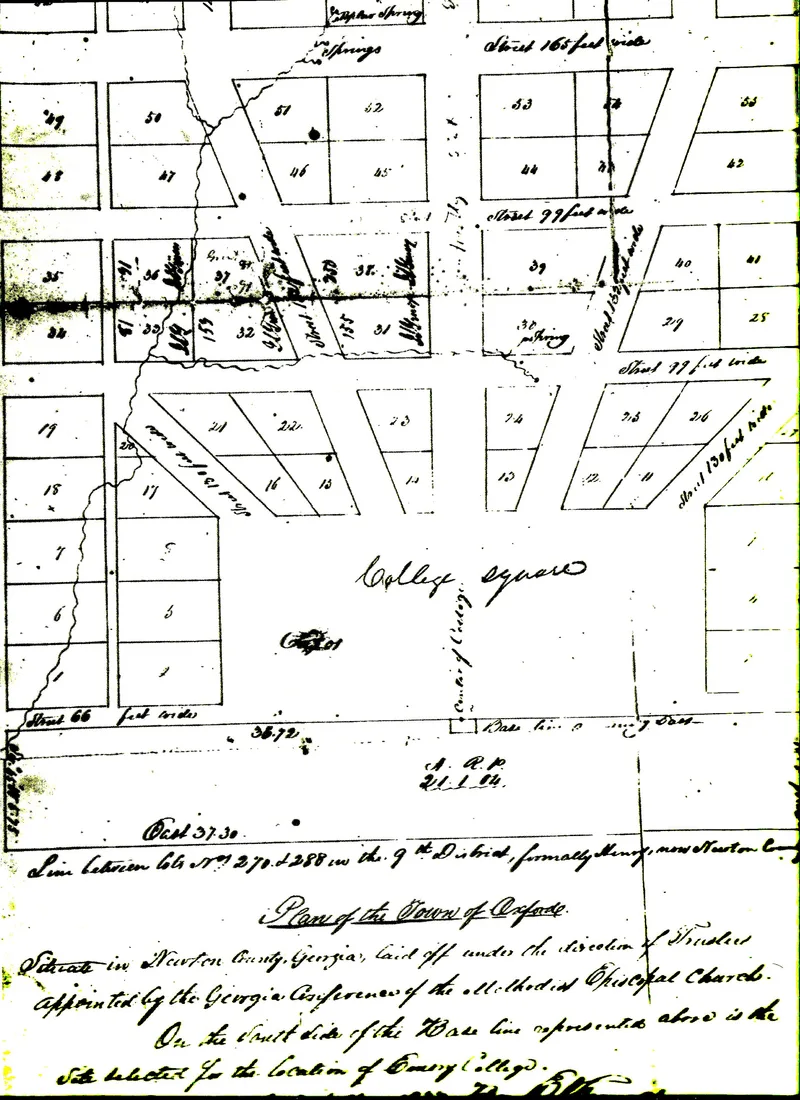
Oxford, Georgia, began in 1837 as a Methodist college town, with about 300 acres set aside for a Christian collegiate community. Methodist minister and surveyor Edward Lloyd Thomas laid out the plan, with streets radiating from the campus of Emory College, now Oxford College of Emory University. The district covers 146 acres and includes the campus, the 1841 Old Church, two cemeteries, a few commercial buildings and many residences. Phi Gamma Hall and Few Hall, built in the early 1850s, are cited as the most important Greek Revival buildings, while Seney Hall represents Victorian Gothic design. The town was home to college presidents, educators, a Confederate spy named Zora Fair and the cotton experimenter David Dickson. Atticus Haygood delivered his sermon "The New South" in the Old Church in 1880. The nomination describes Oxford as perhaps the only town planned under Methodist Church direction, and it was later named a United Methodist Historic Shrine.
Significance in brief: The nomination argues the district is significant as an early nineteenth-century planned community and a center of Methodist educational history. It is also significant architecturally for its many well-maintained nineteenth-century buildings, including Greek Revival, Victorian Gothic and Neo-classical examples. Notable residents and events tied to Methodism, education and Southern history add to its importance.
Machine-generated summary. This summary was generated by a language model from the official nomination document and has not been reviewed line by line by an editor. It may contain errors. Check the source document before relying on any detail. Source: nomination document (PDF) · National Archives catalog entry. NRHP reference 75000603, listed June 5, 1975. Summary generated October 2026 (model claude-sonnet-5-5, prompt v1.0-2026-10-29, confidence medium).
Key facts
| Address | College and residential district centered around Wesley St., Oxford |
|---|---|
| County | Newton County |
| Listed | June 5, 1975 |
| Reference number | 75000603 |
| Resource type | District |
| Architect / builder | Edward Lloyd Thomas, surveyor |
| Architectural style | Greek Revival, Victorian Gothic, Neo-classical and plain style frame structures |
| Areas of significance | Community Planning and Development, Education, Architecture, Religion |
| Level of significance | National |
| Status (as stated in the nomination) | Condition marked good and altered; the street plan is described as unaltered from Thomas's original design, and the form notes some mid-twentieth-century intrusions. |
| Acreage | 146 |
| Coordinates | 33.62549, -83.87018 (NPS GIS) |
What listing means for this property
This is a historic district. Buildings within its boundary are either contributing (they add to the district's significance) or non-contributing. Owners of contributing income-producing buildings can claim the 20% federal rehabilitation tax credit; homeowners should look at state credits. National Register districts impose no design review by themselves; a local historic district ordinance, if one exists, does (the difference explained).
General information, not legal or tax advice. Rules change; confirm with your State Historic Preservation Office or a qualified adviser.
Sources and further reading
- National Park Service, National Register of Historic Places database (snapshot May 2026), reference 75000603.
- Nomination form (PDF, National Archives) — catalog entry
- Wikipedia article (used for cross-checking only; text not reproduced here)
- Wikidata Q7115359
- This listing as JSON
Last updated October 2026. Found an error? See the editorial policy for how to report it.