Ripley, Sam, Farm

Why it's listed
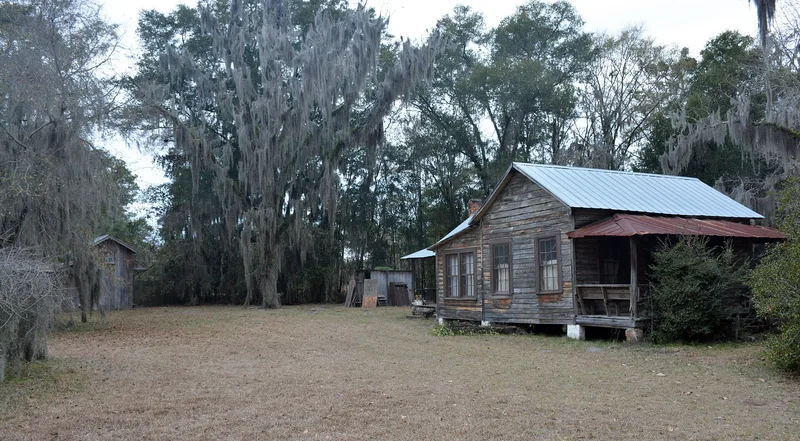
Sam Ripley Farm is a 2.5-acre homestead in the rural lowlands of eastern Liberty County, Georgia, near Midway. Sam Ripley, a subsistence farmer born in 1900, built the frame hall-parlor house in 1926 using salvaged lumber from demolition sites and sawmills. Rooms were later added to the rear. The house keeps its novelty-board siding, brick piers, six-over-six windows, and a shed-roof porch with peeled-log posts. A c.1940 grape arbor, a c.1950 shed, mature trees, and fields complete the farmstead. Ripley grew peas, corn, vegetables, and rice to feed his family and to trade, and he worked at the nearby Whitland Saw Mill. The property is recognized locally as a surviving example of the farms African-American families developed in the Midway and Dorchester area. It is also valued as a vernacular house that grew over time. The house now operates as a bed and breakfast, and the fields are still cultivated.
Significance in brief: The farm is presented as a good example of an African-American subsistence farmstead of the early to mid-20th century, tied directly to farmer Sam Ripley. Its house is also a good example of a vernacular hall-parlor dwelling that grew through later historic additions. It is significant locally in agriculture, architecture and black ethnic heritage.
Machine-generated summary. This summary was generated by a language model from the official nomination document and has not been reviewed line by line by an editor. It may contain errors. Check the source document before relying on any detail. Source: nomination document (PDF) · National Archives catalog entry. NRHP reference 04001187, listed October 27, 2004. Summary generated October 2026 (model claude-sonnet-5-5, prompt v1.0-2026-10-29, confidence high).
Key facts
| Address | 1337 Dorchester Village Rd., Midway |
|---|---|
| County | Liberty County |
| Listed | October 27, 2004 |
| Reference number | 04001187 |
| Resource type | Building |
| Period of significance | 1926-1954 |
| Architectural style | OTHER: hall-parlor |
| Criteria |
|
| Areas of significance | Agriculture, Architecture, Black |
| Level of significance | Local |
| Status (as stated in the nomination) | The house was rehabilitated in 1995 and is currently used as a bed and breakfast; the fields are still cultivated with sugar cane and Seminole peas. |
| Acreage | 2.5 |
| Coordinates | 31.76114, -81.36970 (NPS GIS) |
What listing means for this property
National Register listing is honorary for a privately owned home: it does not by itself restrict what an owner may do with their own money, and it does not require public access. Restrictions come from local landmark or historic-district ordinances, which are separate (how they differ).
Owner-occupied houses are not eligible for the 20% federal rehabilitation tax credit, which applies to income-producing buildings, but many states offer credits for homeowners. Listing also opens the door to preservation easements and to buying a plaque. Start with what listing means for homeowners, renovating a listed house and selling one.
General information, not legal or tax advice. Rules change; confirm with your State Historic Preservation Office or a qualified adviser.
Sources and further reading
- National Park Service, National Register of Historic Places database (snapshot May 2026), reference 04001187.
- Nomination form (PDF, National Archives) — catalog entry
- Wikipedia article (used for cross-checking only; text not reproduced here)
- Wikidata Q85847144
- This listing as JSON
Last updated October 2026. Found an error? See the editorial policy for how to report it.