Porter-York House

Why it's listed
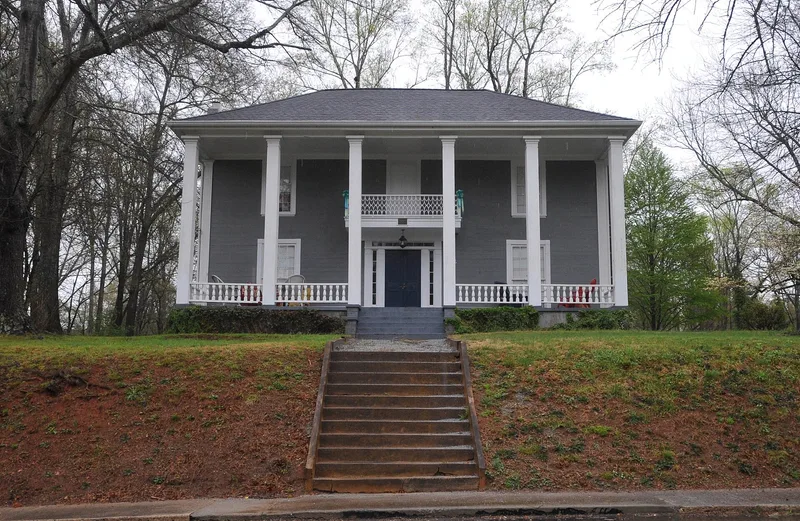
Built between 1861 and 1863 on Bridge Street in Clarkesville, this L-shaped Greek Revival house has a central hall plan with a two-story recessed porch, square hand-fluted columns, a hipped roof, and a cantilevered balcony with delicate cutwork in its balustrade. Inside are a bracketed staircase, carved mantels, and relatively low ceilings. The house is believed to have been designed and built by its first owner, Porter, who bought the lot in December 1860. His widow sold it in 1863, and it passed through several owners before a Porter descendant, M.C. York, bought it at auction in 1902. York, a dry goods merchant, founded the Standard Telephone Company in 1904, and the town's first telephone line ran between this house and his downtown store. The house is valued as a largely unaltered example of late antebellum carpenter-builder work and as the only large Greek Revival structure remaining in Clarkesville. It remains in good condition.
Significance in brief: Architecturally, it is a fine and relatively unaltered example of Greek Revival in its carpenter-builder mode, and the only large Greek Revival structure remaining in Clarkesville. It is also significant for commerce and communications as the early 20th century home of M.C. York, a dry goods merchant who founded the Standard Telephone Company in 1904.
Machine-generated summary. This summary was generated by a language model from the official nomination document and has not been reviewed line by line by an editor. It may contain errors. Check the source document before relying on any detail. Source: nomination document (PDF) · National Archives catalog entry. NRHP reference 82002441, listed August 18, 1982. Summary generated October 2026 (model claude-sonnet-5-5, prompt v1.0-2026-10-29, confidence medium).
Key facts
| Address | Bridge St., Clarkesville |
|---|---|
| County | Habersham County |
| Listed | August 18, 1982 |
| Reference number | 82002441 |
| Resource type | Building |
| Architect / builder | John Porter |
| Architectural style | Greek Revival |
| Areas of significance | Commerce, Architecture, Communications |
| Level of significance | Local |
| Status (as stated in the nomination) | Described as virtually unaltered and in good condition; used as a vacation or summer residence. |
| Acreage | 3 |
| Coordinates | 34.61774, -83.52719 (NPS GIS) |
What listing means for this property
National Register listing is honorary for a privately owned home: it does not by itself restrict what an owner may do with their own money, and it does not require public access. Restrictions come from local landmark or historic-district ordinances, which are separate (how they differ).
Owner-occupied houses are not eligible for the 20% federal rehabilitation tax credit, which applies to income-producing buildings, but many states offer credits for homeowners. Listing also opens the door to preservation easements and to buying a plaque. Start with what listing means for homeowners, renovating a listed house and selling one.
General information, not legal or tax advice. Rules change; confirm with your State Historic Preservation Office or a qualified adviser.
Sources and further reading
- National Park Service, National Register of Historic Places database (snapshot May 2026), reference 82002441.
- Nomination form (PDF, National Archives) — catalog entry
- Wikidata Q134362917
- This listing as JSON
Last updated October 2026. Found an error? See the editorial policy for how to report it.