Alcovy Road Grist Mill
Also known as: Freeman's Mill; Swann's Mill

Why it's listed
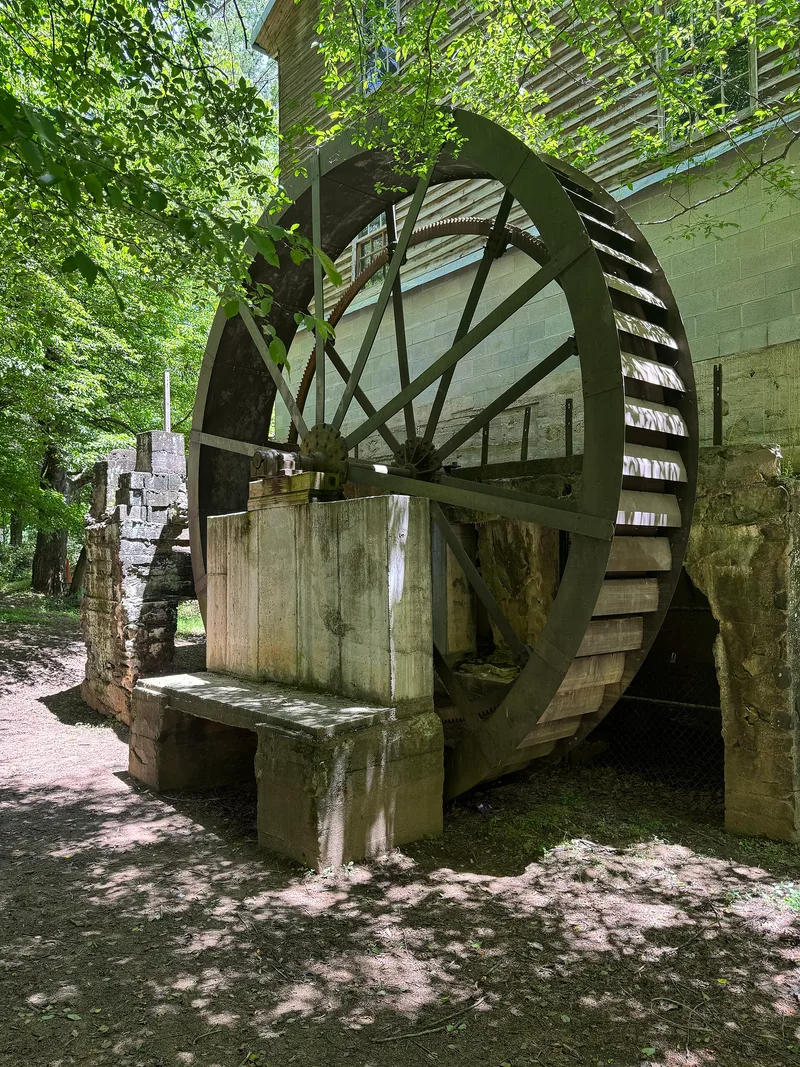
Alcovy Road Grist Mill is a water-powered milling complex on the east side of the Alcovy River, about five miles east of Lawrenceville in Gwinnett County, Georgia. The two-and-one-half story mill was built between 1868 and 1879 with hand-hewn timbers joined by mortise and tenon and wooden pegs. The complex also includes a V-shaped stone dam from about 1910, two mill races with gates, a historic waterwheel, and the site of the miller's house. Most of the interior machinery, including the millstones, belts and gears, remains in place. The mill ground grain until 1986 and in the 1930s supplied meal to state prison camps and a hospital at Lula. It was listed as a good example of utilitarian rural mill design, as a reminder of Georgia's agricultural economy, and for the surviving relationship among river, race and mill. Few operable grist mills remain in the state.
Significance in brief: The nomination argues the mill is one of the last remaining grist mills in Gwinnett County and the state that could still operate, because its machinery is largely intact. It is cited as a good example of utilitarian rural mill design with heavy timber framing and of 19th- and early 20th-century hydropower engineering. It also represents Georgia's rural milling industry and a surviving mill landscape.
Machine-generated summary. This summary was generated by a language model from the official nomination document and has not been reviewed line by line by an editor. It may contain errors. Check the source document before relying on any detail. Source: nomination document (PDF) · National Archives catalog entry. NRHP reference 98000885, listed July 23, 1998. Summary generated October 2026 (model claude-sonnet-5-5, prompt v1.0-2026-10-29, confidence high).
Key facts
| Address | 1564 Alcovy Rd., Dacula |
|---|---|
| County | Gwinnett County |
| Listed | July 23, 1998 |
| Reference number | 98000885 |
| Resource type | District |
| Period of significance | 1868-1948 |
| Architect / builder | unknown (family history says John Griffin Loveless and Levi J. Loveless built the mill) |
| Architectural style | OTHER/Utilitarian |
| Criteria |
|
| Areas of significance | Architecture, Engineering, Industry, Landscape Architecture |
| Level of significance | State |
| Status (as stated in the nomination) | Listed as vacant/not in use; the mill ceased operating in 1986 but is described as in good condition and could be made operational with a small amount of maintenance. The miller's house was destroyed by fire. |
| Acreage | 3.2 |
| Coordinates | 33.96293, -83.92636 (NPS GIS) |
What listing means for this property
This is a historic district. Buildings within its boundary are either contributing (they add to the district's significance) or non-contributing. Owners of contributing income-producing buildings can claim the 20% federal rehabilitation tax credit; homeowners should look at state credits. National Register districts impose no design review by themselves; a local historic district ordinance, if one exists, does (the difference explained).
Noted as vacant in the nomination. Nomination documents can be decades old; current status may differ. If you are considering buying an empty listed property, read the due-diligence checklist.
General information, not legal or tax advice. Rules change; confirm with your State Historic Preservation Office or a qualified adviser.
Sources and further reading
- National Park Service, National Register of Historic Places database (snapshot May 2026), reference 98000885.
- Nomination form (PDF, National Archives) — catalog entry
- Wikipedia article (used for cross-checking only; text not reproduced here)
- Wikidata Q128800184
- This listing as JSON
Last updated October 2026. Found an error? See the editorial policy for how to report it.