Gordon-Banks House
Why it's listed
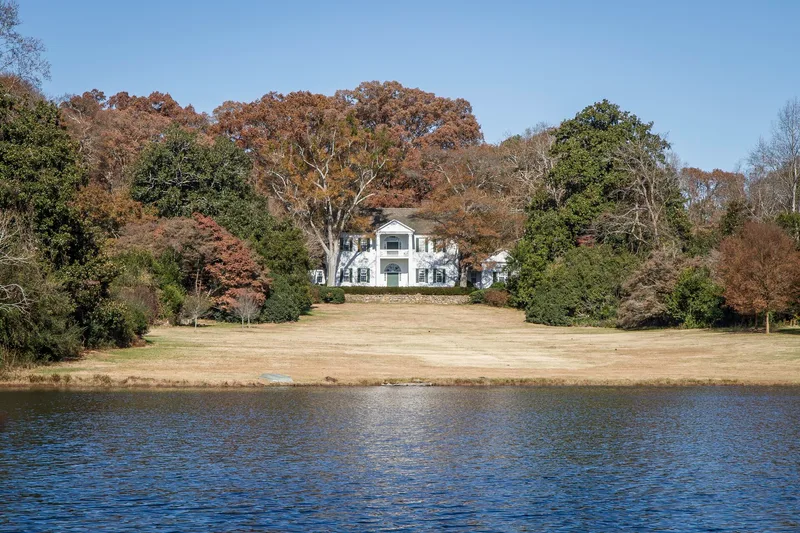
Built around 1827 at Haddock, Georgia, this massive two-story white clapboard house was designed and built by Daniel Pratt for John W. Gordon, a militia general and wealthy cotton planter. Pratt, a New Hampshire native, built several classical town houses and plantation seats in Baldwin and Jones counties between 1821 and 1831, a group considered unique in the southern Piedmont. The house has a pair of fluted Tuscan columns rising to a balcony and pediment, fine fanlights, a circular stair ending in a plaster dome, and eight Adam-inspired mantels. Downstairs rooms keep their original paint, with varied wood-graining and marbleizing. After years of abandonment, the house was moved to Newnan in 1969-70 and set among established gardens beside a small lake. Wings matching Pratt's design replaced vanished outbuildings. The restoration returned it to near its original appearance, and it is valued as a refined example of early Georgia architecture.
Significance in brief: The nomination argues the house is an outstanding work by architect-builder Daniel Pratt, one of a group of classical houses unique in the southern Georgia Piedmont. Its interior retains refined Federal detailing, original paint and decorative plaster. The house also documents the social life of 1820s Milledgeville, and its restoration and gardens add to its value.
Machine-generated summary. This summary was generated by a language model from the official nomination document and has not been reviewed line by line by an editor. It may contain errors. Check the source document before relying on any detail. Source: nomination document (PDF) · National Archives catalog entry. NRHP reference 72000383, listed January 20, 1972. Summary generated October 2026 (model claude-sonnet-5-5, prompt v1.0-2026-10-29, confidence high).
Key facts
| Address | S of Newnan on U.S. 29, Newnan |
|---|---|
| County | Coweta County |
| Listed | January 20, 1972 |
| Reference number | 72000383 |
| Resource type | Building |
| Period of significance | c. 1827; 1969-70 (19th and 20th centuries) |
| Architect / builder | Daniel Pratt (architect-builder); built for John W. Gordon |
| Architectural style | Classical revival, rather Roman than Greek, with Adam-inspired and Federal interior detailing |
| Areas of significance | Architecture |
| Level of significance | National |
| Status (as stated in the nomination) | Condition listed as excellent, altered and moved; occupied as a private residence. It had stood unoccupied and abandoned for many years before being moved and restored. |
| Acreage | 100 |
| Coordinates | 33.34127, -84.78347 (NPS GIS) |
What listing means for this property
National Register listing is honorary for a privately owned home: it does not by itself restrict what an owner may do with their own money, and it does not require public access. Restrictions come from local landmark or historic-district ordinances, which are separate (how they differ).
Owner-occupied houses are not eligible for the 20% federal rehabilitation tax credit, which applies to income-producing buildings, but many states offer credits for homeowners. Listing also opens the door to preservation easements and to buying a plaque. Start with what listing means for homeowners, renovating a listed house and selling one.
General information, not legal or tax advice. Rules change; confirm with your State Historic Preservation Office or a qualified adviser.
Sources and further reading
- National Park Service, National Register of Historic Places database (snapshot May 2026), reference 72000383.
- Nomination form (PDF, National Archives) — catalog entry
- Wikidata Q134289345
- This listing as JSON
Last updated October 2026. Found an error? See the editorial policy for how to report it.