Ruff's Mill and Concord Covered Bridge

Approximate location: the National Park Service places this pin arbitrarily within the property, not at a surveyed point (stated accuracy ±12 m).
Why it's listed
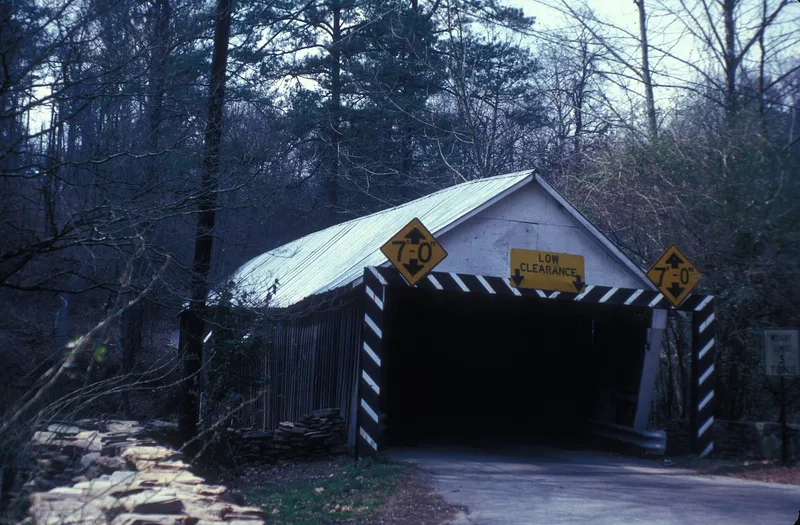
Along Nickajack Creek in Smyrna, Georgia, a miller's house, a gristmill and a covered bridge form a small rural mill complex. The house dates from about 1850 and follows the Plantation Plain form, later given Victorian touches. The fieldstone mill is an unusual example of antebellum stone construction, since most Georgia mills were wooden. The 1872 Concord Covered Bridge, built by Martin L. Ruff and Robert Daniell, is 133 feet long with Queenpost trusses of heart-pine and iron rods. It is one of 17 covered bridges left in Georgia and one of only two with this truss type. The mill survived the Battle of Ruff's Mill on July 4, 1864, part of the Atlanta Campaign. In the 1930s landscape architect William C. Pauley laid out formal gardens and terraces behind the house for Dr. Clinton Reed. Together the buildings, waterworks remains and bridge convey how such complexes once looked and worked.
Significance in brief: The nomination argues that the house, mill and bridge together show a once-common rural mill complex that has largely disappeared in Georgia. It cites industrial, military (the Battle of Ruff's Mill, July 4, 1864), transportation, architectural, landscape architectural and historic archaeological significance. The bridge is one of 17 remaining covered bridges in Georgia and one of two with a Queenpost truss.
Machine-generated summary. This summary was generated by a language model from the official nomination document and has not been reviewed line by line by an editor. It may contain errors. Check the source document before relying on any detail. Source: nomination document (PDF) · National Archives catalog entry. NRHP reference 80001001, listed November 24, 1980. Summary generated October 2026 (model claude-sonnet-5-5, prompt v1.0-2026-10-29, confidence high).
Key facts
| Address | 10 Concord Rd., SW, Smyrna |
|---|---|
| County | Cobb County |
| Listed | November 24, 1980 |
| Reference number | 80001001 |
| Resource type | District |
| Period of significance | 1800-1899, 1900- |
| Architect / builder | Covered bridge built by Martin L. Ruff and Robert Daniell (1872); 1930s landscaping by William C. Pauley |
| Architectural style | Plantation Plain (miller's house, with Victorian alterations); Queenpost truss covered bridge |
| Areas of significance | Industry, Landscape Architecture, Historic - Non-Aboriginal, Military, Engineering, Transportation, Architecture |
| Level of significance | State |
| Status (as stated in the nomination) | The two-story mill has been used for some social events and now stands vacant. The miller's house is occupied as a private residence, and the bridge remains in day-to-day use. |
| Acreage | 3.5 |
| Coordinates | 33.84909, -84.55840 (NPS GIS) |
What listing means for this property
This is a historic district. Buildings within its boundary are either contributing (they add to the district's significance) or non-contributing. Owners of contributing income-producing buildings can claim the 20% federal rehabilitation tax credit; homeowners should look at state credits. National Register districts impose no design review by themselves; a local historic district ordinance, if one exists, does (the difference explained).
General information, not legal or tax advice. Rules change; confirm with your State Historic Preservation Office or a qualified adviser.
Sources and further reading
- National Park Service, National Register of Historic Places database (snapshot May 2026), reference 80001001.
- Nomination form (PDF, National Archives) — catalog entry
- Wikipedia article (used for cross-checking only; text not reproduced here)
- Wikidata Q58904102
- This listing as JSON
Last updated October 2026. Found an error? See the editorial policy for how to report it.