Athens Factory
Also known as: Old Mill, The

Why it's listed
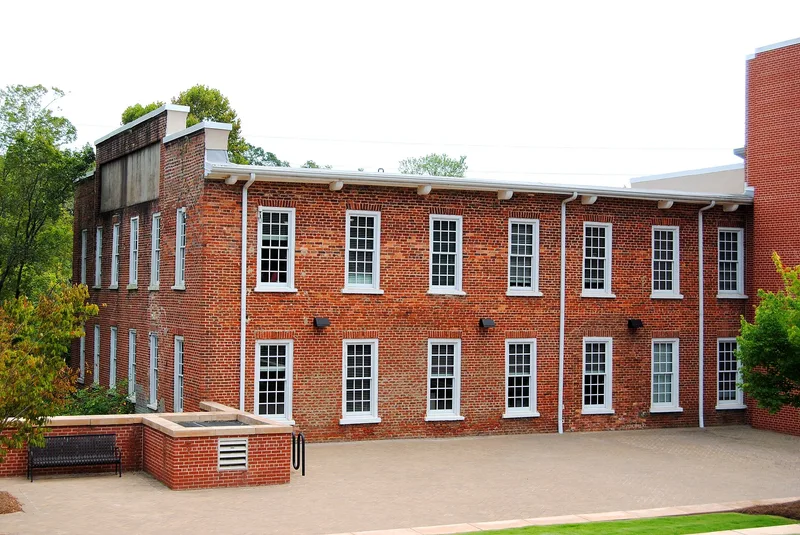
Beside the North Oconee River in Athens, two connected brick buildings form an L: a three-story wool building and a longer, four-story cotton building. Athens Factory opened in 1833 as a cotton and wool mill, burned in 1834 and again in 1857, and was rebuilt in brick in 1858. At one time it was the largest of the Clarke County factories, making cotton and woolen yarns and cloth. Its riverside location, dam, millrace and spillway show how local waterpower drove industry, and its thick brick walls, large windows and timber floors follow standard mill construction. Roofs were later flattened to create usable upper floors. After textile operations ended, the buildings served for storage and used-machinery sales. From 1978 they were converted into a tavern, restaurant and shopping arcade. Former service buildings are gone, but historical maps suggest buried archaeological remains that could clarify the factory's early development.
Significance in brief: The nomination argues the site is a characteristic water-powered factory complex of the second half of the nineteenth century, showing industrial growth in that period. Its fireproof load-bearing brick walls, large windows and slow-burning timber interiors tie it to mainstream industrial architecture. The site also has inferred archaeological potential, and the buildings have been adapted to new uses.
Machine-generated summary. This summary was generated by a language model from the official nomination document and has not been reviewed line by line by an editor. It may contain errors. Check the source document before relying on any detail. Source: nomination document (PDF) · National Archives catalog entry. NRHP reference 80000989, listed July 31, 1980. Summary generated October 2026 (model claude-sonnet-5-5, prompt v1.0-2026-10-29, confidence medium).
Key facts
| Address | Baldwin and Williams Sts., Athens |
|---|---|
| County | Clarke County |
| Listed | July 31, 1980 |
| Reference number | 80000989 |
| Resource type | District |
| Period of significance | 1800-1899 |
| Architect / builder | Unknown |
| Areas of significance | Industry, Historic - Non-Aboriginal, Architecture |
| Level of significance | Local |
| Status (as stated in the nomination) | Adapted into the Old Mill Center, with a tavern/restaurant and a mini-mall of shops in the former mill buildings; original machinery has not survived. |
| Acreage | 2.3 |
| Coordinates | 33.95285, -83.36929 (NPS GIS) |
What listing means for this property
This is a historic district. Buildings within its boundary are either contributing (they add to the district's significance) or non-contributing. Owners of contributing income-producing buildings can claim the 20% federal rehabilitation tax credit; homeowners should look at state credits. National Register districts impose no design review by themselves; a local historic district ordinance, if one exists, does (the difference explained).
General information, not legal or tax advice. Rules change; confirm with your State Historic Preservation Office or a qualified adviser.
Sources and further reading
- National Park Service, National Register of Historic Places database (snapshot May 2026), reference 80000989.
- Nomination form (PDF, National Archives) — catalog entry
- Wikidata Q141737628
- This listing as JSON
Last updated October 2026. Found an error? See the editorial policy for how to report it.