Canton Historic District

Why it's listed
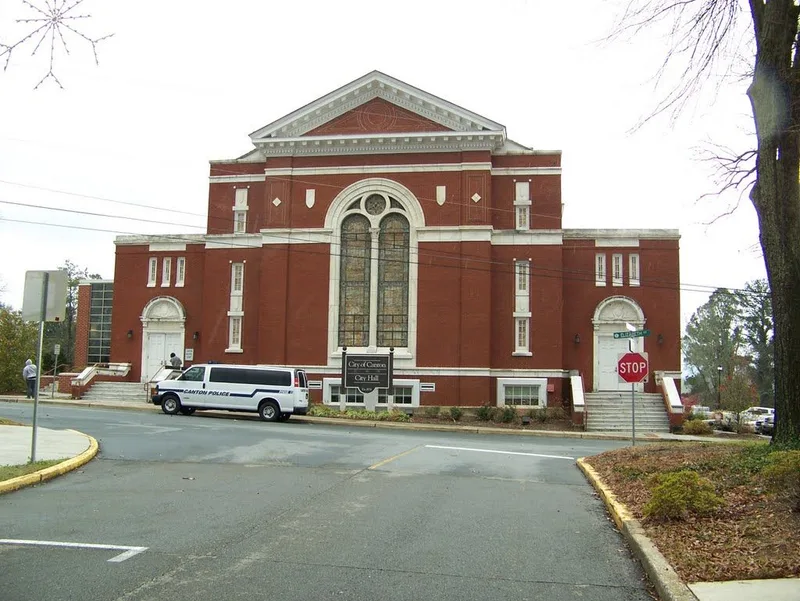
Canton is the Cherokee County seat in north Georgia, and its historic district takes in most of the old city along Main Street between the Etowah River and Jeanette Street. The district holds 331 contributing resources built between 1833 and 1960. Downtown has attached brick storefronts from the 1890s to the 1940s, alongside landmarks such as the 1929 marble Cherokee County Courthouse, the 1928 post office, the 1940 Art Moderne Canton Theatre, and two schools from 1914 and 1924. Down by the river and the railroad, a cotton mill that began operating in 1900, a wholesale warehouse and other plants drove the city's growth, and nearby rows of small mill houses sheltered workers. Residential areas include the African-American neighborhood known as Stumptown, plus cemeteries and Brown Park. The district was recognized for its commerce, industry, planning, government and architecture, reflecting Canton's role as a regional center from the late 1800s to the mid-1900s.
Significance in brief: The district is argued to represent Canton's role as a regional center of commerce and industry from the late 19th to mid-20th century. It also reflects community planning shaped by hilly terrain and the city's long role as county seat. Its commercial, industrial, governmental and residential buildings represent architectural styles and types common in Georgia cities of the period.
Machine-generated summary. This summary was generated by a language model from the official nomination document and has not been reviewed line by line by an editor. It may contain errors. Check the source document before relying on any detail. Source: nomination document (PDF) · National Archives catalog entry. NRHP reference 10000803, listed September 23, 2010. Summary generated October 2026 (model claude-sonnet-5-5, prompt v1.0-2026-10-29, confidence high).
Key facts
| Address | Roughly centered on Main St between the Etowah River on the W and Jeanette St on the E, Canton |
|---|---|
| County | Cherokee County |
| Listed | September 23, 2010 |
| Reference number | 10000803 |
| Resource type | District |
| Period of significance | 1833-1960 |
| Architectural style | Late Victorian (Italianate, Queen Anne); Late 19th and 20th Century Revivals (Beaux Arts, Colonial Revival, Classical Revival, Tudor Revival, Late Gothic Revival); Bungalow/Craftsman; Moderne |
| Criteria |
|
| Areas of significance | Architecture, Commerce, Industry, Community Planning and Development, Politics/Government |
| Level of significance | Local |
| Status (as stated in the nomination) | Mixed current use: the district retains commercial, government, school, religious, residential and industrial functions; some individual buildings, such as the former Bank of Canton, are noted as vacant. |
| Acreage | 276.3 |
| Coordinates | 34.23577, -84.48518 (NPS GIS) |
What listing means for this property
This is a historic district. Buildings within its boundary are either contributing (they add to the district's significance) or non-contributing. Owners of contributing income-producing buildings can claim the 20% federal rehabilitation tax credit; homeowners should look at state credits. National Register districts impose no design review by themselves; a local historic district ordinance, if one exists, does (the difference explained).
General information, not legal or tax advice. Rules change; confirm with your State Historic Preservation Office or a qualified adviser.
Sources and further reading
- National Park Service, National Register of Historic Places database (snapshot May 2026), reference 10000803.
- Nomination form (PDF, National Archives) — catalog entry
- Wikidata Q34870339
- This listing as JSON
Last updated October 2026. Found an error? See the editorial policy for how to report it.