Paradise Gardens
Also known as: Paradise Garden; Plant Farm Museum

Why it's listed
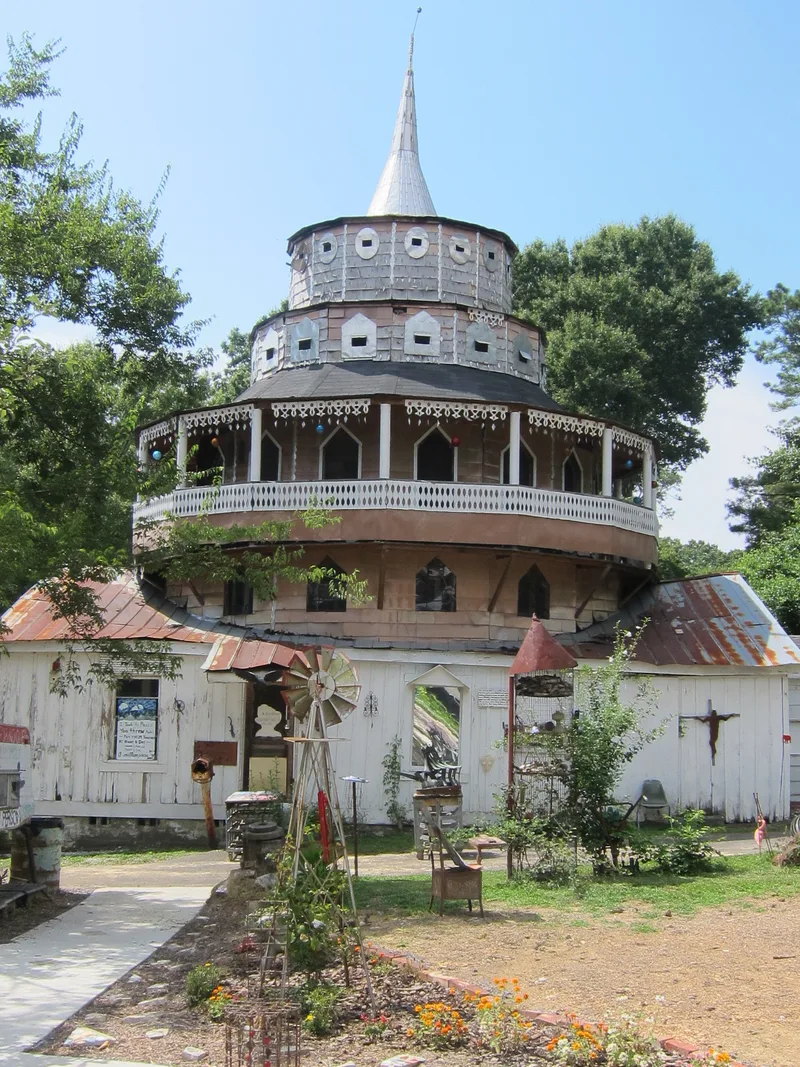
Paradise Gardens is an outdoor art environment in Pennville, in northwest Georgia, built by self-taught artist Howard Finster while he lived on the block between 1961 and 1991. Finster drained low-lying land with canals, then filled it with concrete walkways and walls studded with colored glass, bottles, tiles, bicycle parts and other found objects. The property includes his former houses, studios, a barn, a bicycle repair shop, a meditation chapel, a long covered bridge, and the five-story World's Folk Art Church, which many scholars consider his most important work. After a vision in 1976, Finster devoted himself to sacred art, and Biblical themes run through the grounds. It was listed because of its direct association with Finster, whose paintings and sculptures were shown in major museums and galleries across the United States and internationally, including the Venice Biennale. Today parts of the site serve as museums and a visitor center.
Significance in brief: The district is argued to be nationally significant in the area of art because of its direct association with Howard Finster, a major 20th-century folk artist. His work was exhibited widely in the United States and abroad, including at the Venice Biennale. The gardens also rank among the notable visionary-art environments in the country.
Machine-generated summary. This summary was generated by a language model from the official nomination document and has not been reviewed line by line by an editor. It may contain errors. Check the source document before relying on any detail. Source: nomination document (PDF) · National Archives catalog entry. NRHP reference 12000166, listed March 26, 2012. Summary generated October 2026 (model claude-sonnet-5-5, prompt v1.0-2026-10-29, confidence medium).
Key facts
| Address | 84 Knox St., Pennville |
|---|---|
| County | Chattooga County |
| Listed | March 26, 2012 |
| Reference number | 12000166 |
| Resource type | District |
| Architect / builder | Howard Finster |
| Architectural style | Other: visionary art environment |
| Criteria |
|
| Areas of significance | Art, Architecture |
| Level of significance | National |
| Status (as stated in the nomination) | Includes a museum and visitor center; the Bicycle Tower has settled and rusted from weather exposure and the storage shed is in poor condition. Some artworks have been removed to private collectors and museums. |
| Acreage | 4 |
| Coordinates | 34.51246, -85.31645 (NPS GIS) |
What listing means for this property
This is a historic district. Buildings within its boundary are either contributing (they add to the district's significance) or non-contributing. Owners of contributing income-producing buildings can claim the 20% federal rehabilitation tax credit; homeowners should look at state credits. National Register districts impose no design review by themselves; a local historic district ordinance, if one exists, does (the difference explained).
General information, not legal or tax advice. Rules change; confirm with your State Historic Preservation Office or a qualified adviser.
Sources and further reading
- National Park Service, National Register of Historic Places database (snapshot May 2026), reference 12000166.
- Nomination form (PDF, National Archives) — catalog entry
- Wikipedia article (used for cross-checking only; text not reproduced here)
- Wikidata Q30608000
- This listing as JSON
Last updated October 2026. Found an error? See the editorial policy for how to report it.