Bonaventure Cemetery
Also known as: Bonaventure Plantation; Evergreen Cemetery
Why it's listed
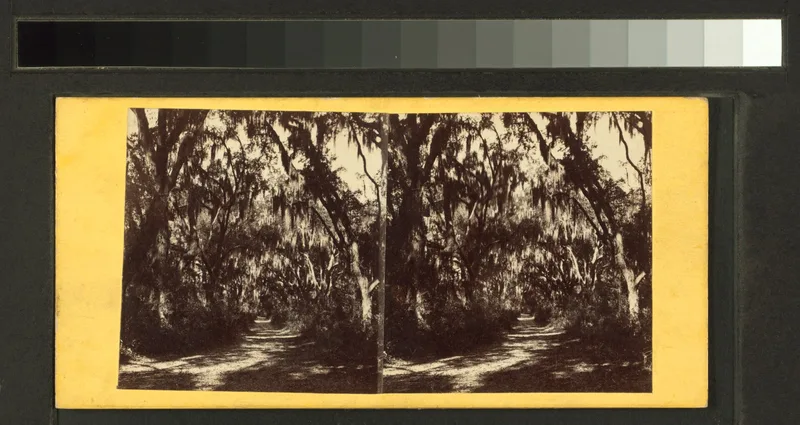
Bonaventure Cemetery occupies 160 acres on a bluff above the Wilmington River in Savannah. It began in 1846, when Peter Wiltberger bought the 600-acre Bonaventure Plantation and set aside 70 acres for burials. The City of Savannah bought it in 1907 and enlarged it by 1909, adding a Jewish section. Live oaks line the unpaved avenues, and the layout follows the Rural Cemetery tradition of a landscaped, picturesque burial ground. The grounds hold about 6,010 burials, 25 historic mausoleums, obelisks, iron fences and sculpture. More than 100 works are attributed to German-born sculptor John Walz, including the Gracie Watson monument. Two buildings survive: a brick gatehouse built before 1900 and a Jewish chapel from 1917, believed to be the only Jewish chapel in a city cemetery in Georgia. The cemetery was listed for its art, architecture, landscape design, community development and Jewish heritage, with a period of significance of 1846 to 1950.
Significance in brief: The nomination argues the cemetery is significant in art, architecture, landscape architecture, community planning and Jewish ethnic heritage. It holds 25 historic mausoleums and over 100 sculptures by John Walz, and it follows the Rural Cemetery movement. Its Jewish chapel of 1917 is believed to be the only one in a city cemetery in Georgia.
Machine-generated summary. This summary was generated by a language model from the official nomination document and has not been reviewed line by line by an editor. It may contain errors. Check the source document before relying on any detail. Source: nomination document (PDF) · National Archives catalog entry. NRHP reference 01000035, listed February 2, 2001. Summary generated October 2026 (model claude-sonnet-5-5, prompt v1.0-2026-10-29, confidence high).
Key facts
| Address | Bonaventure Rd., 1 mi. N of US 80, Savannah |
|---|---|
| County | Chatham County |
| Listed | February 2, 2001 |
| Reference number | 01000035 |
| Resource type | District |
| Period of significance | 1846-1950 |
| Architect / builder | Architects Henry Urban and Henrik Wallin of Savannah; landscape architect James H. Rion; sculptors including John Walz, Antonio Aliffi, Civiletti, W.F. Pietch and Struthers; ironwork by M. Ely of Newark, N.J. |
| Criteria |
|
| Areas of significance | Art, Architecture, Community Planning and Development, Other-Ethnic, Landscape Architecture |
| Level of significance | State |
| Status (as stated in the nomination) | The cemetery remains open and active, operated by the City of Savannah. The former caretaker's house serves as the office and visitors' center. |
| Acreage | 160 |
| Coordinates | 32.04506, -81.04477 (NPS GIS) |
What listing means for this property
This is a historic district. Buildings within its boundary are either contributing (they add to the district's significance) or non-contributing. Owners of contributing income-producing buildings can claim the 20% federal rehabilitation tax credit; homeowners should look at state credits. National Register districts impose no design review by themselves; a local historic district ordinance, if one exists, does (the difference explained).
General information, not legal or tax advice. Rules change; confirm with your State Historic Preservation Office or a qualified adviser.
Sources and further reading
- National Park Service, National Register of Historic Places database (snapshot May 2026), reference 01000035.
- Nomination form (PDF, National Archives) — catalog entry
- Wikipedia article (used for cross-checking only; text not reproduced here)
- Wikidata Q4941210
- This listing as JSON
Last updated October 2026. Found an error? See the editorial policy for how to report it.