Bowdon Historic District
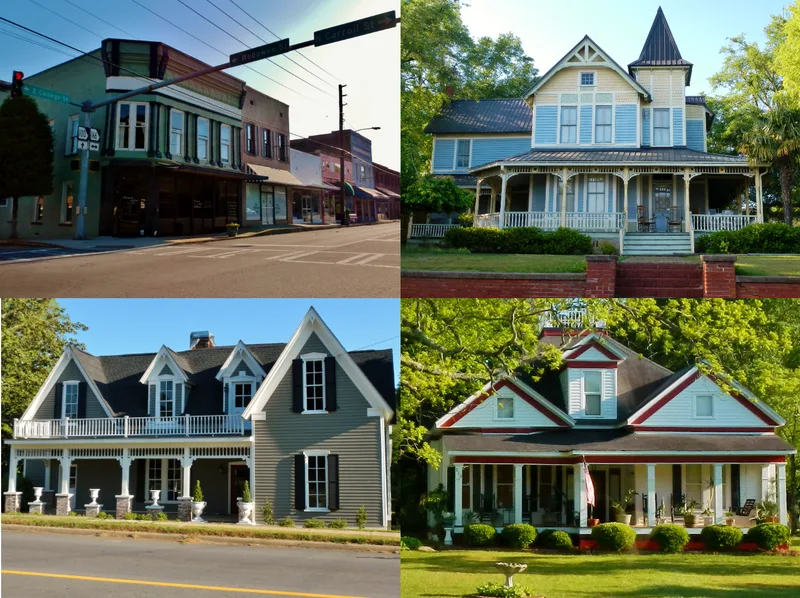

Why it's listed
Bowdon's historic district covers the town's core along College and Wedowee streets, about 14 miles west of Carrollton in Carroll County, Georgia. It includes houses from the mid-19th century to the mid-20th century, mostly bungalows and Georgian cottages, along with Queen Anne, Gothic Revival and Folk Victorian examples. Downtown, one- and two-story brick stores with corbeled brickwork sit flush to the lot line, alongside a 1939 service station and a 1920s auto dealership. The Sewell clothing plant, begun in 1933 by brothers Warren, Robert and Roy Sewell, helped the town weather the Depression and, with a sister plant in Bremen, grew into one of the country's ten largest makers of men's clothing. Landmarks include a 1909 Gothic Revival Methodist church, a 1948 Moderne city hall and a 1960 International Style post office. The railroad arrived in 1910, and a 1934 tornado prompted rebuilding and updating of many buildings.
Significance in brief: The district documents Bowdon's growth as a crossroads town and later a textile manufacturing center, anchored by the Sewell clothing plant founded in 1933. It retains a varied collection of house types, commercial buildings and community landmarks. Many commercial buildings were rebuilt or updated after a 1934 tornado.
Machine-generated summary. This summary was generated by a language model from the official nomination document and has not been reviewed line by line by an editor. It may contain errors. Check the source document before relying on any detail. Source: nomination document (PDF) · National Archives catalog entry. NRHP reference 09001056, listed December 8, 2009. Summary generated October 2026 (model claude-sonnet-5-5, prompt v1.0-2026-10-29, confidence medium).
Key facts
| Address | Roughly centered along GA 166 and GA 100, Bowdon |
|---|---|
| County | Carroll County |
| Listed | December 8, 2009 |
| Reference number | 09001056 |
| Resource type | District |
| Architectural style | Queen Anne, Gothic, Colonial Revival, Tudor Revival (English Vernacular Revival), Bungalow/Craftsman, International Style, Moderne, Folk Victorian |
| Areas of significance | Architecture, Commerce, Community Planning and Development |
| Level of significance | Local |
| Status (as stated in the nomination) | Many historic buildings remain in use, including a service station operating since 1939 and the Sewell clothing plant complex; a few resources are noncontributing. |
| Acreage | 478 |
| Coordinates | 33.53900, -85.25583 (NPS GIS) |
What listing means for this property
This is a historic district. Buildings within its boundary are either contributing (they add to the district's significance) or non-contributing. Owners of contributing income-producing buildings can claim the 20% federal rehabilitation tax credit; homeowners should look at state credits. National Register districts impose no design review by themselves; a local historic district ordinance, if one exists, does (the difference explained).
General information, not legal or tax advice. Rules change; confirm with your State Historic Preservation Office or a qualified adviser.
Sources and further reading
- National Park Service, National Register of Historic Places database (snapshot May 2026), reference 09001056.
- Nomination form (PDF, National Archives) — catalog entry
- Wikidata Q141715461
- This listing as JSON
Last updated October 2026. Found an error? See the editorial policy for how to report it.