Strathy Hall

Why it's listed
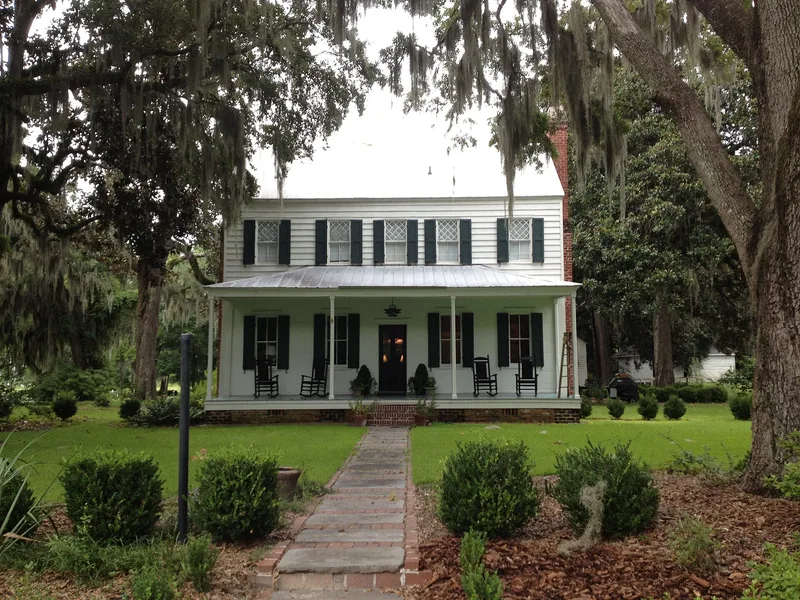
Strathy Hall is a two-story frame house on the Ogeechee River southeast of Richmond Hill, Georgia, dated to about 1840. Its plan is Plantation Plain: two rooms over two rooms with no central hall, weatherboard siding, a one-story hip-roofed porch and brick end chimneys. Three outbuildings, including a possible granary, share the grounds, and an avenue of oaks leads to the river. The land was granted in 1756 to Captain James MacKay, who named it after his brother's Scottish estate. In 1817 it passed to Colonel George W. McAllister, whose rice plantation relied on large enslaved labor. After the Civil War the estate was held by executors, then by the Clay family until 1925. Henry Ford then acquired it as one of the first parts of his Richmond Hill plantation and stripped away later additions to reveal the original core. The house was listed for its plantation history and as an example of early restoration work.
Significance in brief: The nomination argues it was the seat of a large eighteenth and nineteenth century plantation and later part of Henry Ford's twentieth century Richmond Hill plantation. Architecturally it is an early example of the Plantation Plain style and of early twentieth century restoration techniques. Its ownership ran from a Scottish colonist through coastal Georgia farmers to a Northern industrialist.
Machine-generated summary. This summary was generated by a language model from the official nomination document and has not been reviewed line by line by an editor. It may contain errors. Check the source document before relying on any detail. Source: nomination document (PDF) · National Archives catalog entry. NRHP reference 79000701, listed January 21, 1979. Summary generated October 2026 (model claude-sonnet-5-5, prompt v1.0-2026-10-29, confidence medium).
Key facts
| Address | SE of Richmond Hill, Richmond Hill |
|---|---|
| County | Bryan County |
| Listed | January 21, 1979 |
| Reference number | 79000701 |
| Resource type | Building |
| Architect / builder | Unknown |
| Architectural style | Plantation Plain |
| Areas of significance | Agriculture, Architecture, Social History |
| Level of significance | Local |
| Status (as stated in the nomination) | Described as in excellent to good condition and occupied as a private residence; the house was restored in the 1920s after Henry Ford removed later additions. |
| Acreage | 3.6 |
| Coordinates | 31.90416, -81.25132 (NPS GIS) |
What listing means for this property
National Register listing is honorary for a privately owned home: it does not by itself restrict what an owner may do with their own money, and it does not require public access. Restrictions come from local landmark or historic-district ordinances, which are separate (how they differ).
Owner-occupied houses are not eligible for the 20% federal rehabilitation tax credit, which applies to income-producing buildings, but many states offer credits for homeowners. Listing also opens the door to preservation easements and to buying a plaque. Start with what listing means for homeowners, renovating a listed house and selling one.
General information, not legal or tax advice. Rules change; confirm with your State Historic Preservation Office or a qualified adviser.
Sources and further reading
- National Park Service, National Register of Historic Places database (snapshot May 2026), reference 79000701.
- Nomination form (PDF, National Archives) — catalog entry
- Wikipedia article (used for cross-checking only; text not reproduced here)
- Wikidata Q14686844
- This listing as JSON
Last updated October 2026. Found an error? See the editorial policy for how to report it.