North Broad Street Residential Historic District

Why it's listed
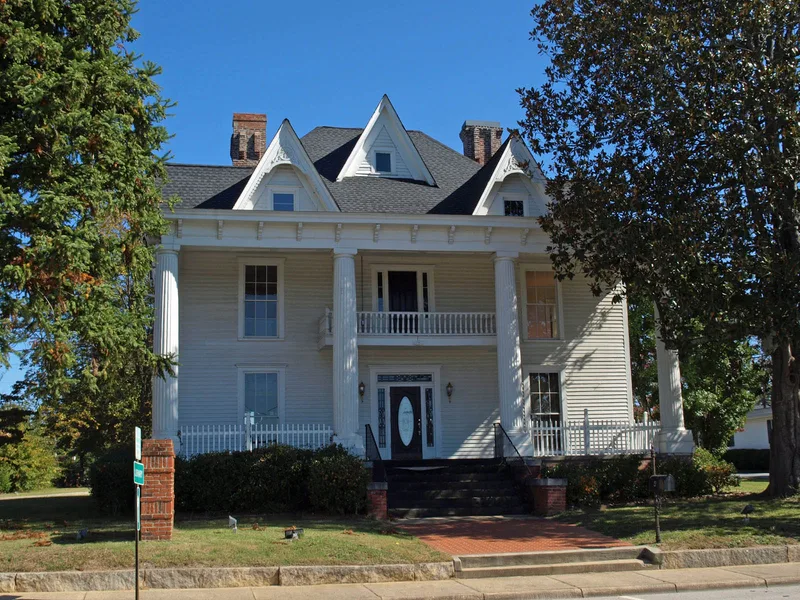
North of Winder's central business district lies a residential neighborhood of about 18 acres that grew up after railroads reached the town in the 1880s and 1890s. Its houses range from small Victorian frame cottages to the ornate 1902 Smith-Baxter House, with scrollwork, shingles and a wrap-around porch. Neoclassical houses with monumental porticos, many Bungalows, and a few 1930s brick Tudor houses fill out the streets. The only non-residential building is the Gothic First Baptist Church, built between 1907 and 1914. Large lots, mature trees, shrubs and hedgerows give the area a green, nearly rural character that sets it apart from the commercial core. Residents included merchants, manufacturers, bankers and dentists who shaped the town's economic and civic life. By the mid-1930s the district looked much as it does now. Later commercial growth altered its edges, but an intact historic neighborhood remains. It was listed for its architecture, landscape design and local history.
Significance in brief: The district is argued to be significant in architecture for good local examples of Victorian, Neoclassical, Bungalow and Gothic styles over about fifty years. It is also significant in landscape architecture for its green, almost rural residential setting, which contrasts with the commercial area. In local history, its residents contributed to the economic, social, political and religious life of Winder.
Machine-generated summary. This summary was generated by a language model from the official nomination document and has not been reviewed line by line by an editor. It may contain errors. Check the source document before relying on any detail. Source: nomination document (PDF) · National Archives catalog entry. NRHP reference 84000888, listed July 26, 1984. Summary generated October 2026 (model claude-sonnet-5-5, prompt v1.0-2026-10-29, confidence high).
Key facts
| Address | Roughly bounded by Woodlawn Ave., Center, Broad, and Stephens Sts., Winder |
|---|---|
| County | Barrow County |
| Listed | July 26, 1984 |
| Reference number | 84000888 |
| Resource type | District |
| Period of significance | 1880s-1930s |
| Architect / builder | Various |
| Architectural style | Victorian, Neoclassical, Bungalow, Gothic and Tudor styles |
| Criteria |
|
| Areas of significance | Landscape Architecture, Architecture |
| Level of significance | Local |
| Status (as stated in the nomination) | Described as an intact historic residential neighborhood with a few intrusions and non-historic buildings; condition marked good and altered. Present use is private residence and religious. |
| Acreage | 18 |
| Coordinates | 33.99550, -83.71821 (NPS GIS) |
What listing means for this property
This is a historic district. Buildings within its boundary are either contributing (they add to the district's significance) or non-contributing. Owners of contributing income-producing buildings can claim the 20% federal rehabilitation tax credit; homeowners should look at state credits. National Register districts impose no design review by themselves; a local historic district ordinance, if one exists, does (the difference explained).
General information, not legal or tax advice. Rules change; confirm with your State Historic Preservation Office or a qualified adviser.
Sources and further reading
- National Park Service, National Register of Historic Places database (snapshot May 2026), reference 84000888.
- Nomination form (PDF, National Archives) — catalog entry
- Wikipedia article (used for cross-checking only; text not reproduced here)
- Wikidata Q14686760
- This listing as JSON
Last updated October 2026. Found an error? See the editorial policy for how to report it.